1.3 Research objectives
The focus of this research paper is to provide a comprehensive
theoretical background aimed at understanding the phenomenon of code switching.
Besides, providing a viable sociopsychological framework is interesting in
analyzing the data collected from Chenini Berber speakers in order to
investigate the instances of Tunisian Arabic-Berber code switching.
One further objective is to analyze the data collected in the
light of a sociopsychological approach, namely Communication Accommodation
Theory in order to determine the variables operating under speakers' choice.
Besides, it is worth mentioning that studying Berber language makes people in
Tunisia aware that Berber language is still spoken in the country and they are
even proud of speaking a distinct variety in addition to Tunisian Arabic.
Chenini Berbers' attitudes toward their language are meaningfully assessed in
the light of their ethnolinguistic vitality to survive as a distinctive group
minority.
1.4 Research questions
Code switching has been brought under investigation in
different fields of research. The sociolinguistic approach to code switching
attempts to answer the question of «which bilingual communities show
language alternation in which situation and why» (Auer 1984, p. 1).
Social-psychology tries to establish a relationship between soda-psychological
motivations and the phenomenon of code switching. Taking into consideration the
broad scope of investigation of code switching, it seems Vital to answer the
following question: what is code switching? The answer, therefore, should
provide a multidimensional understanding of the phenomenon since it relates to
different fields of research.
4
The present study attempts to answer the following questions
in order to achieve the objectives mentioned in the previous section:
(1) What are the variables affecting Chenini Berber speakers'
choice of languages?
(2) Since code switching could be investigated from a variety
of disciplines, what are the sociopsychological motivations underlying Tunisian
Arabic- Berber code switching among Chenini Berber speakers? How do they do
that?
1.5 Structure of the memoire
This research is divided into five main sections, which are
introduction, literature review, methodology and findings and discussion and it
ends--up with a conclusion. The literature review provides an overview of the
phenomenon of code switching. Moreover, defining code switching includes
distinguishing the term from other language contact phenomena such as
borrowing. In order to demonstrate how the perception of code switching has
changed throughout the course of research history, several definitions will be
considered which reveal the different viewpoints on the subject. The chapter
also presents a review of early and recent work on Berber starting from the
assumption that, as mentioned above, the Tunisian Berber dialect is among the
least investigated, a fact which motivated the present work.
The section dedicated to the methodology shows a
sociopsychological orientation dealing with code switching. A
sociopsychological approach to language use is reviewed so as to provide a
sociopsycholinguistic framework that serves as the basis for data analysis in
the following part.
The section devoted to the findings and discussion aims at
analyzing the instances of code switching used by Chenini Berber speakers to
identify whether these instances operate under certain variables in language
negotiation. In the
5
same section, there is also the interpretation of the
Berberophones' attitudes toward their Amazigh heritage and language which
represent important indices in language choice as well as the
sociopsychological reasons underlying Tunisian Arabic-Berber code switching.
The conclusion summarizes the implications of Chenini Berber
speakers' mastery of Berber language and instances of Tunisian Arabic-Berber
code switching. Besides, it reveals the limitations of the study especially
that the number of Berber speakers is too limited in Tunisia. However, it
should be noted that the research does not pretend to be an exhaustive one
about Berber in Tunisia, and that there still need to be more studies on this
language, which still survives but is on the verge of extinction.
6
Chapter 2: Literature Review
2.1 Introduction
Extensive research over the last twenty years on language
contact phenomena and especially in the field of code switching has led
investigators to agree that bilinguals' code switching is governed by certain
constraints. For example, there exists a large body of literature on the
structural constraints that are said to determine where and how code switching
could occur. Moreover, concepts such as `power', `authority', `prestige' and `
gender` are all invoked in explaining why, how and when bilinguals switch from
one language to another. This chapter, then, provides a review of research on
code switching and bilingual community.
The first section gives various definitions of code switching
and conflicting viewpoints. Since code switching has some similarities with
borrowing, code mixing and diglossia, which cause difficulty in defining of
code switching in a precise way, we will provide in section 2.3 some criteria
for keeping the language contact phenomena apart. The term bilingualism is
unquestionably related to code switching, that is why it is going to be defined
in section 2.4 in relation to code switching. The chapter further continues
with enumerating the different types of bilingualism. Finally, the chapter
concludes by stating the sociology of Berber and its significance in the
Tunisian context since it is little explored and understood.
2.2 Code switching: definitions and conflicting
viewpoints
When we `speak of «language contact«, we are
undoubtly talking about people speaking different languages coming into contact
with one another. Uriel
7
Weinreich (1953), generally considered to be the first
`theoretician' of language contact, focused mainly on structural principles
rather than on sociolinguistic considerations when he wrote that «In the
interference of two grammatical patterns it is ordinarily the one which uses
relatively free and invariant morphemes in its paradigms which serves as the
model for imitation»(l953: 41). In other words, Weinreich ignores the
language users and the internal states in explaining the language change,
«since change itself is a built-in property of the kind of system that a
human language [...] happens to be» (Loss, 1997). That is to say,
Weinreich, in studying language contact, gives much importance to structural
constraints rather than to the variables which govern the speakers' choice of
language.
Developments in code switching can be attributed to a number
of factors, but the stimulation offered by André-Tabouret-Keller (1985)
is crucial. Keller is extremely clear when he made a distinction between
language choice as a sign of inclusion and code switching to signal detachment
from the group. The «individual creates for himself the patterns of his
linguistic behavior so as to resemble those of the groups with which he wishes
to be identified, or so as to be unlike those from which he wishes to be
distinguished» (André-Tabouret-Keller, 1985:181).
To put it differently, bilingual speakers choose the language
which suits their needs, either for inclusion or exclusion. This reminds us of
what Howard Giles (1977) and his colleagues developed through Communication
Accommodation Theory in underlying language behavior. Their theory serves as an
attempt to explain language choices in terms of convergence and divergence. A
basic postulate of accommodation theory is that people are motivated to adjust
their speech style, or accommodate, as a means of expressing values, attitudes
and intentions towards the other.
8
In addition, people do the majority of their code switching
with people with whom they are most familiar and comfortable (the same age,
gender).This View is consolidated by Kim-Renaud (1986:16), who argues that
«code switching may be viewed as a reflection of the social relationship
between speaker and addressee». In other words, a speaker may choose to
alternate his code because he is talking with a close friend or simply
surrounded by others who code switch. That is, speakers' code switching would
directly be influenced by what they know about their listeners. The less they
know about the participant, the less they would code switch.
Moreover, in metaphorical code switching, an individual may
code switch as he moves from «....the situation formal to informal,
official to personal; serious to humorous, and politeness to solidarity»
(Wardhaugh, 1986: 163). Wardhaugh suggests that although there is a close link
between choice of language and change in social situations, language use, and
code switching in particular, are more dependent on the associations existing
between languages and factors like topic, addressee, situation, purpose and
familiarity with the addressee.
In addition, other researchers such as Davies (1948) study
code switching using Myers-Scotten's «markedness theory» (1993b). In
this connection, Davies (1948: 89), quoted by Cicourel (1974:20) explains that:
«An individual carries his social position around in his head, so as to
speak and puts it into action when the appropriate occasion arises. Not only
does he carry it in his head but others also carry it in theirs, because social
positions are matters of reciprocal expectations and must be publicly and
commonly conceived by everyone in the group»
This quote reveals clearly that speakers choose the form of
their conversation such that it indexes the set of rights and obligations which
they wish to be in force between speaker and addressee for the current
exchange.
9
In addition, the corpus gathered about Moroccan Arabic and
French code switching by Moha Ennaji (2004) suggested that the respondents
associated certain topics, interlocutors, and situations with Arabic, and
associated others with French. He illustrated that «topics like family,
children and friends, and settings like home and street were associated with
Moroccan Arabic. While topics and situations like computing, medicine and
banking were associated with French in the minds of these respondents»
(Ibid: 140).
At the local level, Tunisian Arabic-French code switching
described by Stevens (1974) and El Arbi (2000) suggested that there is no
specific motive for a particular switch. It is rather a communication of a
series of switches which has a role to play in creating an overall style.
Moreover, Hedi Bannour (1989), in studying the language of Tunisian students in
the 1980's, concluded that the respondents code-switch either because of
lexical gaps in MSA and TA, or because they are at a loss for some term or
expression which they can find in French but they cannot find in TA, or vice
versa, or because they want to stress an idea or give more weight to a point of
view, or simply by habit. He added that some code-switch to show off,
especially among females, and to prove that they know French. The snob appeal
of using French is evident particularly among young ladies. (Cited in
Chettaoui, 1983: 51-52)
By the same token, Moha Ennaji went a step further and studied
Berber-Moroccan Arabic bilingualism. He observed that «[....] it seems
that in rural areas, bilingualism is characterized by the acquisition of Arabic
as a second language along with maintenance (Fishman, 1972) of Berber. In the
urban areas, the general tendency is towards the displacement of Berber in
favor of a shift (Fishman, 1972) to Arabic» (Abbassi, 1977:101). The
general lesson to be learnt, however, is that the bilingual speaker has the
ability to switch from one code to another according to specific motives and in
particular point in the conversation.
10
Different variables which govern speakers' choice of languages
such as social relationship, topics, settings and situations have been
considered by many linguists. Each is quite complex by itself and needs to be
considered alone. This study, however, tries to figure out the variables which
operate under Chenini Berber speakers' choice of language given the fact that
Tunisian Arabic-Berber code switching has little been investigated.
In Tunisia, although some researchers have worked on code
switching (Stevens, 1974, B1 Arbi, 2000, Belazi, 1991), little concern has been
attached to Tunisian Arabic-Berber code switching. There is a need, I felt, to
go a step further and investigate this new dimension of code switching in
Tunisia and mainly in Tataouine. The present study, then, attempts to direct
attention to an additional dimension in research on code switching and tries to
fill a gap at the local level.
The present research investigates the sociopsychological
factors underlying code switching in the south of Tunisia, namely in Chenini.
Thus, Tunisian Arabic-Berber code switching is at the core of the present
research. Attitudes and opinions toward the languages studied constitute also
the research concern since they direct the speakers' choice for one particular
code as the situation demands. But before we engage in answering these
questions, a distinction between code switching and other related phenomena
needs to be made.
2.3 Code switching, code mixing, borrowing and
diglossia
Every language contact phenomenon needs to be understood apart
in order to avoid any confusion since there are some researchers who sometimes
want to study code switching in relation to other language behavior such as
code mixing. Li (1996), for example, maintains that «code switching or
language mixing occurs when a word or a phrase in one language substitutes for
a word or phrase in a second language». As the definition above suggests,
the output of code
11
switching bears a significant resemblance to the patterning of
the mixed languages.
Bakker (2003:129), however, claimed that `mixed languages' do
not arise from code switching. Bakker (2003), in the context of an argument
against mixed languages arising fi`om code switching, states that code
switching is only found where both languages involved in the code switching are
held in esteem by the speakers. Similarly, Grosjean (1982) prefers to discuss
code switching independently from other language contact phenomena such as
borrowing and code mixing. He states that «Code switching is the alternate
use of two or more languages in the same conversation» Grosjean (1982).
According to the author, code switching is the alternation between two or more
codes either in the same utterance or conversation.
Yet, a satisfactory definition of code switching requires that
this term be distinguished from other related terms like borrowing, code mixing
and diglossia which are the focus of the following section.
2.3.1 Code switching vs. code mixing
A distinction has often been made in the literature between
code switching and code mixing. Researchers (e.g. William C. Ritchie and Tej K.
Bhatia, 1996) use the term-code switching to refer to «the use of various
linguistic units (words, phrases, clauses, and sentences) primarily from two
participating grammatical systems across sentence boundaries within a speech
event» (p.312). In other words, this view suggests that code switching is
intersentential. The same writers use the term code mixing to refer to
«the mixing of various linguistic units (morphemes, words, modifiers and
sentences) primarily from two participating grammatical systems within a
sentence». In other words, code mixing is intrasentential and is
constrained by grammatical principles.
12
In defining these language contact phenomena, some
sociolinguists acknowledge only the functional dimension in contrast to the
grammatical principles between these codes. In this regard, Torres (1989, 420)
states that: «In code switching, unlike code mixing, a change in the
social situation motivates the alternation of codes.» To put it
differently, the speaker chooses his or her code according to the social
situation involved in the conversation (formal to informal, official to
personal, serious to humorous...). (Cited in Moha Ennaji, 2004:139).
In the literature, code switching may refer to two different
phenomena. For instance, Pfaff (1979:295) states that «code switching and
borrowing are subcategories of the general phenomena of code mixing». The
same writer employs the term «mixing» for code mixing and borrowing.
While Beardsome (1991 :49) rejects even the use of the term code mixing
«since it appears to be the least favored designation and the most unclear
for referring to any form of non-monoglot norm-based speech pattern».
Yet others use the term «code mixing» to refer to
other related phenomena such as borrowing, interference, transfer or switching
(Mc, Laughlin, 1984:967). Instead of clarifying the phenomenon of code
switching, these researchers have blurred it further by introducing new terms.
Thus, Pakin (1989), for instance, introduced the term code selection. As its
name indicates, code selection involves a deliberate choice of the speaker in
his or her codes.
2.3.2 Code switching and borrowing
As code switching has been defined in the above section apart
from code mixing, borrowing needs also to be distinguished from code switching.
Moha Ennaji (2004: 143) assumed that «Borrowing is involved when single
vocabulary items, phrases, or frozen expressions from one language are used in
the target language». According to the writer, borrowed words or loans
are
13
integrated in the grammatical system of the borrowing
language. To illustrate, Ennaji gives an example uttered by Moroccan
Arabic-French bilingual:
e.g. Xdina la permission «We got the permission»
Code switching, however, «occurs when there is a
juxtaposition of strings of words formed according to the patterns and
grammatical systems of the languages involved» (Ibid).
Other researchers (e.g., Carol Myers Scotton, 1988), however,
acknowledge the distinction between code switching and borrowing in a different
way. Scotton (1988: 159) states that the distinction between code switching and
borrowing can be clarified only «if it is approached in terms of social
content, not structure». In other words, Scotton ignores the grammatical
systems of the codes involved and concentrates instead on the social content.
Loans or borrowed items, according to Scotton, enjoy a high frequency of use
and a great deal of social acceptability. Borrowed words are fully integrated
in the target language to the extent that they are difficult to recognize as
foreign loans. By contrast, switches belong to the individual register and
enjoy a small degree of social integration and acceptability.
In this study, however, I do not make a distinction between
code mixing on the one hand and other related phenomena (e.g., borrowing) on
the other hand, for the simple reason that the grammar of code switching is
beyond the scope of this research. Instead, I use «language mixing/code
switching» (LM/S) as a cover term for both mixing and code switching
(Bhatia and Ritchie, 1996).Thus, when the term code switching is used here, it
refers only to code switching.
14
2.3.3 Code switching and diglossia
It is with Ferguson (1959), that the concept of diglossia is
most often associated. Ferguson used the term diglossia to denote situations
where two dialects of the same language are used for different functions, but
the two varieties are used in complementary domains and functions. The high
variety (H) is utilized informal and public domains (e.g. religion and
literature) and the low (L) variety is used in more informal and private
domains (e.g. the family and friends). Ferguson (1959: 435) defines diglossia
as: «a relatively stable language situation in which, in addition to the
primary dialects of the language, there is a very divergent, highly codified
superposed variety, the vehicle of a large and respected body of written
literature, either of an earlier period or in another speech community, which
is learned largely by formal education and is used for most written and spoken
purposes but is not used by any section of the community for ordinary
conversation». Therefore, diglossia, in Ferguson's View refers to the use
of either varieties a dialects of the same language in different settings.
However, Ferguson restricts the term diglossia to dialects that are genetically
related. As a result, Fishman (1967, 1965, 1980) `extends' this idea to include
two separate languages as well as to complex cases where more than two dialects
and/or languages may be involved.
Fishman (1967) introduced also the notion that diglossia could
be extended to situations found in many societies where forms of two
genetically unrelated languages occupy the H and L niches. The high language is
used for religious, educational and literacy domains, while another language is
rarely used for such purposes, beingonly employed for more informal, primarily
spoken domains. As such, diglossia is a variable phenomenon. But what remains
important to the authors and peculiar to diglossia, is the functional
specialization of H and L. «In one set of situations, only H is
appropriate, while in another, only L» (Romaine, 1989: 31).
15
Hudson (1980) judges Ferguson's definition of the term to be a
bit confusing since each bilingual community with one language for different
functions will be in this sense, diglossic. That is why a distinction between
code switching and diglossia should be made.
According to Gumperz (1982:60) since «diglossia is the
case where distinct varieties are employed in certain settings [...] that are
associated with separate bounded kinds of activities»; it is safe to say
that diglossia is a case of situational code alternation par excellence. In
this instance, we can conclude that situational code switching is a kind of
speech style used by bilinguals in every day interaction. Thus, it is different
from borrowing and diglossia.
According to Garmadi (1983: 3), there are three different
varieties of Arabic spoken in Tunisia: (i) Classical Arabic, a variety which is
used in Koranic recitals and Friday sermons; (ii) Modern Standard Arabic (MSA),
a variety which is strongly influenced by French syntax, the language of
newspapers and radio broadcasts; (iii) Elevated Arabic (EA) or in Garmadi's
words the «polite spoken Arabic». This is the language of educated
Tunisians and politicians.
Besides these three varieties, there is another one in which
French and Tunisian Arabic intermingle. This variety contains many loans words,
some of which have been fully integrated into the Tunisian Arabic phonological
and morphological system. Many educated Tunisians who have completed a
significant part of their studies in French use both Tunisian Arabic and French
simultaneously. Consequently, one can conclude that the linguistic situation in
Tunisia is Diglossic. In Maamouri's words:
This linguistic role differentiation between CLA [i.e, Classical
Arabic]
and TA [Tunisian Arabic] shows complementary social functions and
proves that there was, in pre-1956 Tunisia, what is usually referred to as a
16
state of diglossia, a situation where two distinct related
languages are used side-by-side throughout a speech community, each with a
clearly defined role, on top of a «bilingualism» that involved French
and opposed to it to one or the other of the two varieties of Arabic.
(Maamouri, 1983:13), cited in Gabsi, 2003: 18-19)
2.4 Code switching and bilingualism
Although there are no precise statistics on the number or
distribution of speakers of two or more languages, Grosjean (1982: Vii)
estimated that probably about half of the world's population is bilingual
(Cited in Suzanne Romaine, 1997: 385). That is, the number of speakers of two
or more languages is of great importance in the world. Code switching cannot be
examined independently from bilingualism since code switchers are necessarily
called bilinguals.
2.4.1Definition of the term bilingualism Mackey
(1962: 51) reminded us that:
«Bilingualism is not a phenomenon of language; it is a
characteristic of its use. It is not a feature of the code but of the message.
It does not belong to the domain of «langue» but of
«parole». If language is the property of the group, bilingualism is
the property of the individual".
(Mackey, 1962: 51, cited in Li Wei, 2003: 276)
From the above definition, bilingualism, in Mackey's View,
corresponds to De Saussure's distinction between langue and parole. Mackey
considers bilingualism as a property of the individual not of the group as a
whole. Bilingualism is a behavioural pattern of mutually modifying linguistic
practises
17
varying in degree, function, alternation, and interference. It
is in terms of these four inherent characteristics that bilingualism may be
described (Mackey, 1959).
Some researchers (Bloomfield, 1933; Haugen, 1953) agree that
being a bilingual allows users to achieve native-like proficiency in two
languages. Thus, Bloomfield (193.3: 56) defined bilinguals as individuals who
have «native-like control of two languages». This View was broadened
later on by Haugen to the ability to produce «complete meaningful
utterances in the other language» (Haugen, 1953: volume 1, p.7).
However, one can not admit that bilinguals are always able to
switch between languages equally. In fact, a bilingual usually masters one
language better than the other and not many bilinguals have native-speaker
competence and fluency in two languages. For that, perfect bilingualism is
generally rare because full mastery of two languages is hard to achieve. In
this connection, Spolsky (1988) states that:
«[. . .] if we count as a bilingual only someone with
equal and native command of two or more languages, we exclude that vast
majority of cases and are left with the least interesting, In practice, then,
scholars in the field treat bilingualism as a relative rather than an absolute
phenomenon, and consider anyone able to produce or even understand sentences in
more than one language as the proper object of their study». (pp.
100-101)
According to Spolsky, then, the question of
«perfection» in two languages is a relative one. That is why we can
argue that there is no agreed upon definition of bilingualism among researchers
because it has multidimensional aspects. Hence, bilingualism is not static. In
sum, different ways to conceptualize someone`s proficiency in two languages
have been proposed, and accordingly there are a number of challenges in
assessing a bilingual individual's «proficiency» in his or her two
languages.
18
But it is important to emphasize that bilingual speakers have
a unique linguistic and psycholinguistic profile; their two languages are
constantly in different states of activation and they are able to call upon
their linguistic knowledge and resources according to the context and adapt
their behaviour to the task at hand (Li Wei, 2000). That is to say, bilingual
speakers are able to select their codes as the situation demands/requires.
As far as this research is concerned, the question of
proficiency in two languages is beyond the researcher's interest since the
grammar of code switching is also not undertaken in this research paper.
However, Haugen's definition of bilingualism is rather adopted. In Haugen's
View, bilingualism is treated as «a cover term for people with different
language skills, having in common only that they are not monolinguals».
Haugen's definition refers to the contact of different languages and cultures
which may bring about a bilingual situation or a multilingual situation.
That is why bilingualism has some benefits since individuals
are exposed to more than one culture. For instance, speakers under study are
exposed to two cultures i.e., Arabic culture and Berber culture, which
facilitate their integration with other group minorities. Bilinguals, who
switch from one language to another, can be more expressive since they are not
limited to just one language. They have a choice as to what language to use and
thereby have the ability to select the word that most clearly captures the
essence of what they are trying to communicate.
For the bilingual speaker, the availability of various
languages in the community repertoire serves as a useful interactional
resource. Typically, bilingual speakers tend to assign different roles to
different languages. For example, one language may be used in informal contexts
with family and friends, while another for the more formal situations at work,
education and government. In addition to the clarification of the term
«bilingualism», we must
19
include the different classifications of bilinguals which are
the concern of the following subsection.
2.4.2 Different types of bilinguals
Different classifications of individual bilinguals depending
on which dimensions of bilingualism they focus on have been proposed by
researchers. For example, the distinction between balanced and dominant (or
unbalanced) bilinguals (Peal and Lambert, 1962) is based on the relationship
between the proficiencies of the receptive languages that bilinguals master.
Balanced bilinguals are those who acquire similar degrees of proficiency in
both languages, whereas dominant bilinguals are individuals whose proficiency
in one language is higher than that in the other language(s). `Balanced
bilingual' is a term used to define those whose mastery of both codes is more
roughly equivalent. They constitute rare if not non-existent species.
There are some other basic matters that focus on the
dimensions of how two or more linguistic varieties are organized by
individuals. (Weinreich, 1953). For instance, a distinction can be made between
compound and coordinate bilingualism. In «compound bilingualism» two
different languages form a merged system, whereas in «coordinate
bilingualism» two different languages are kept apart in the mind of the
individual. For example, in studying Berber - Moroccan Arabic bilingualism,
Moha Ennaji (2004:123) observed that Berber-Moroccan Arabic bilingualism, as
used in cities, is «compound bilingualism» because both languages are
used hand in hand for the same socio-economic purposes, while Berber-Moroccan
Arabic bilingualism in rural areas is a case of «coordinate
bilingualism» because Arabic is predominant in the public sphere, in
schools, in courts, mosques, public offices, while Berber prevails in the rural
areas and at home. Similarly, Bell (19761120) notices that «bilingualism
is viewed as a scale running from the compound bilingual, in whom two
languages
20
form a merged system to the coordinate bilingual, in whom the
two language systems are kept distinct» (Bell, 1976:120).
Lambert (1974) suggested other dimensions in classifying
bilingual speakers. According to Lambert, bilinguals who can enhance their L2
without losing their L1 proficiency are called additive bilinguals; whereas
those whose L2 was acquired or learned at the expense of losing L1 have been
labelled subtractive bilinguals.
The most important hallmark of bilingualism and diglossia is
the fact that they are variable phenomena. The relationship between
bilingualism and diglossia has been described by Fishman (1967, 1972, 1980).
«While Diglossia refers to societal arrangements that help maintain
boundaries between the societal functions associated with H and L»,
bilingualism refers to «an individual behavioral manifestation». In
addition, the concept of diglossia is sociological, as opposed to the concept
of bilingualism, which is an individual skill.
In this research, Chenini Berber speakers are referred to as
«bilinguals» since they are able to speak two different languages,
namely Shilha and Tunisian Arabic among other languages such as French. They
are sometimes called by their type's as additive or subtractive bilinguals. For
instance, Chenini Berber speakers are called «subtractive bilinguals»
when they learn Arabic at the expense of their Berber language in the sense
that so many Berber words become arabized. These Chenini Berber speakers are at
the core of this research paper; that is why they have to be examined. The
starting point should be a description of Berber sociology, followed by stating
some studies which are carried out on Berber in general and in Tunisia in
particular.
21
2.5 Berber
Throughout this section, I will be referring to the Berber
language. First a brief background on the history of Berber is presented,
regarding its sociology and varieties. The study then turns to the present
situation of Berber studies carried out by some linguists. The study culminates
with a report on my fieldwork, where I examine studies on Berber in Tunisia,
which is the focus of the present study.
2.5.1 Sociology of Berber
The origin of the Berber language was a question of a great
debate which goes back to thousands of years. There are three main hypotheses
about the origin of the Berber language. Moha Ennaji (200427), in his study of
Berber in Morocco, has cited these origins in a detailed manner. The first
hypothesis assumes that Berber stems from ancient Egyptian. The second,
however, stipulates that it belongs to the Afro Asiatic language family. The
third hypothesis affiliates Berber to Indo-European and Amerindian languages.
Subsequently, Ennaji was able to conclude that the most plausible theory is to
state that Berber is an Afro-Asiatic language.
The Berber language has three main varieties, namely Tamazight
(in the north and in the Rif Mountains), Tashlehyt (in Middle Atlas and east of
high Atlas) and Tarifit (in the High Atlas and in the south of Morocco).
Nowadays, the largest numbers of Imazighen, as native speakers of Berber call
themselves, live in Morocco and Algeria. In other words, it is in Morocco that
the Berber speaking population is most important, followed by Algeria. A
minority of Berbers (about 50.000) still lives in Tunisia, mainly in Djerba and
in the central south of Tunisia, namely in Tataouine (Chenini and Douiret).
Referring to Berber as a group or a community in this paper
stems from the commonly held belief in the literature that language and
identity are crucial
22
in group identification. For example, Giles et al. (1977: 325)
state that «ethnic groups are an example of linguistic categorization
since they are often found to manifest their distinctiveness from each other by
means of separate language or dialects», and that linguistic
categorization «generally connotes ethnic exclusiveness and solidarity to
native speakers, and, conversely exclusion and opposition when used in
ethnically mixed contexts».
Given the scarcity of Berber studies in Tunisia, this research
aims to show ethnic exclusiveness and solidarity between Chenini Berber
speakers by means of ethnolinguistic vitality. Many people in Tunisia are not
aware that the language, namely Shilha is still spoken in the country and some
educated people even wonder how it can be investigated, asking if it has a
grammar at all. As a starting point, a sub-section needs to be included in
order to show the different studies on Berber before stating Tunisian Berber
studies.
2.5.2 The Berbers in Tunisia
The first known inhabitants of Tunisia are the Berbers or
Libyans. Their settlement dates back to as early as 9,000 BC. Present-day
Berbers live mainly on the island of Jerba and on the mainland of Matmata,
Taoujout, Tamazret, Guermessa, Chenini and Douiret. In Tunisia, Chenini Berbers
refer to themselves as Jbeliyya. They are considered to be among the oldest
inhabitants of the south. Despite government urbanization programmes, they
still prefer to live in their well-maintained ghorfas. They are eager to pass
on their descendents their language and heritage. In the south of Tunisia and
particularly in Tataouine, the appellation Jbeli denotes a person who lives in
Chenini.
2.5.2.1 The Berber village of Chenini
In the last ten years, there has been an interest in
preserving and promoting the Berber population languages spoken in Morocco and
Algeria. The Shilha Berber in Tunisia, however, has received until now little
attention from either
23
foreign or local linguists. Probably less than one percent of
Tunisia's local population speaks Shilha. This figure is low compared with the
Berber population of Morocco and Algeria with thirty five percent and twenty
percent respectively.
The town of Chenini is located approximately sixteen
kilometers from Tataouine. Both Chenini and Douiret are part of the governate
of Tataouine. The elderly people of Chenini believe that their ancestors
settled first, near the mosque of `the Seven Sleepers'. Chenini Berbers came
and built their dwellings near it. They settled first on the qsar and began to
build around it from the very top to the flattest point.
The qsar's architecture is wonderful. It is a building with
small rooms stacked on top of each other in a circle which creates a small
courtyard used to house animals. These rooms or ghorfas (5g ghorfa: is «a
long room covered with a barrel vault roof, with niches set into the long side
walls to enable foodstuffs to be easily stored» (Ministre de La Culture))
are used to mainly as a storage place. In addition, the exterior of qsur have
stairs which were constructed in a random fashion in order to stop rodents
entering these rooms and destroying its content. In Chenini, inhabitants are
very welcoming people, especially when the visitors gain their trust.
In Chenini, the Omda is a highly respected person in the
Village; he still embodies the local govemment's authority. His role is
comparable to the tribe's Sheikh in the past. Any issue relating to the village
or its people is under his control. There are two hundred twenty families
distributed in old and new chenini (2005 statistics) (Cited in Gabsi, 2003
).
2.5.2.2 The status of Shilha in Tunisia
There are numerous reasons which have contributed to the
recession of Berber in Tunisia. Although Pencheon (1983) discussed some of
these factors
24
nearly two decades ago, one finds them to be still applicable
in explaining the situation of Berbers today. These factors may be summarized
in three terms: geographical, economical, and socio-cultural.
First, Berbers in Tunisia are dispersed in small enclaves,
which work against any desire for unity and solidarity. In Pencheon's (1983:
31) words, this `geographical reality' has negative repercussion on the Berber
speakers' attitudes toward their language. Second, the emigration of most
Berber men to work in urban areas and cities creates many problems for the
maintenance of Berber. When Berber men return home after a long absence in the
city, their Berber dialect is simplified and by using Tunisian Arabic in the
household, children began to develop some apathy towards using Berber at home.
Third, the emancipation of Tunisian women since independence enables Berber
women to attend school. As a consequence, they join their husbands to immigrate
to major cities in search for work. This social change plays a crucial role in
the loss of Berber as a vital language at home. Berber women used to be
monolinguals in Berber. In other words, they are the linchpins of language
maintenance. Fourth, Pencheon (1983: 31) discussed that the Berber in Tunisia
are unaware that their language is surviving beyond their small towns. This is
reflected, according to the same writer, in the lack of solidarity between the
Berber towns such as Douiret and Chenini despite their geographical proximity
(only six kilometers separate the two towns). As a result to all these factors,
Shilha in Tunisia gains low prestige.
2.5.3 Different studies on Berber
There is an abundant literature concerning the Berber language
which, from the nineteenth century, started attracting some researchers. The
French occupation of 1912 impacted the way the Arabic and Berber languages were
perceived. During this period, knowledge of French was indispensable for
obtaining power; therefore it was learned by the Moroccan elite (Marley,
2003:
25
28). In this perspective, Chaker (1984: 122) explains that,
because of colonization, «The Berber studies were a quasi monopoly of some
French grammar tradition» (author's translation): « Les études
Berbères étaient un quasi monopole d'une certaine tradition
grammairienne Française. Les recherches et publications ont longtemps
été 1e fait d'amateurs éclairés [...] qui se sont
généralement contentés d'appliquer tel quel au
berbère le cadre de catégories qui l'on reconnaissait dams la
grammaire traditionnelle Française. »
Nowadays, there is a proliferation of studies concerning
Berber; some of them are even made by Berber linguists. For instance, Chaker
(1978) studied the syntax of Kabyle Berber. Then he wrote series of articles
concerning different aspects of Berber, such as the adjective (1985),
derivation (1995), verbal negation (1996), and grammatical gender (1998).
Sadiqi (1997) is another linguist who made a thorough study of
Berber in a book which consists of three parts: the first part is about Berber
phonology, the second part about Berber morphology and the third part is about
Berber syntax. These are some studies on Berber which focused mainly on the
grammatical constraints underlying this language.
2.5.4 Scarcity of Berber studies in Tunisia
Tunisian Berber has attracted some research such as that of
Gabsi (2003), who wrote a doctoral thesis on the Berber dialect of Douiret,
which is a small village near Tataouine. In the abstract of the dissertation,
Gabsi (2003) started by pointing out that «the Tunisian Berber (or
`Shilha') vernaculars are the least described Afro-asiatic (Handthemitic)
languages to this day». In his work, Gabsi described the phonology,
morphology and syntax of Douiret making some comparison with the vernaculars of
Chenini (Tataouine). He claimed that `Shilha' (the vernacular of Douiret) has
some similarities with Kabyle Berber
26
and «Tamazight». Regarding studies on Berber, Gabsi
(2003: 37) states that «the literature on Algerian and Morocco Berber is
plentiful». But, however abundant the Berber literature can be, there is
still a lack of studies concerning the Tunisian Berber dialects.
In fact, Boukous (1988-: 78-) points out that «la
littérature linguistique consacrée aux PBT (Parlers Berber de la
Tunisie) n'est ni abondante ni approfondie»: «linguistic literature
devoted to Tunisian Berber dialects is neither abundant nor through»,
(author's translation). This clearly reveals the paucity in Berber studies in
Tunisia and the strong need to enrich the local level since
Berber speakers are scattered in many parts of the country
(such as Chenini, Douiret, Tamezret and Djerba...etc). This paper is therefore
an attempt to analyze the situation of Berber in Tataouine (Chenini), with
particular emphasis on the instances of Tunisian Arabic-Berber code switching
and the construct of identity starting from language being the marker of
ethnicity. In this instance, we should remember Fishman's (1977) argument in
favor of ethnicity where he highlights the importance and supremacy of language
in ethnicity; he explains (p.25) that a distinct language «is more likely
than most symbols of ethnicity. Language is the recorder of paternity, the
expresser of patrimony and the carrier of phenomenology».
Moreover, Elarbi Ben Mamou (2004), a native speaker of
Tamezret (a small Berber village in the south), has a website which includes
different sections, the most important of which are about lexis and grammar.
However, Ben Mamou himself explains and insists that his work is «the
fruit of nonspecialists' effort and therefore should be merely considered as a
contribution which aims at preserving this dialect from a very rapid
extinction» (author's translation).
27
Like all of the other states that embrace Arab nationalism,
the Republic of Tunisia does not officially recognize any indigenous
ethnolinguistic minority within its borders. Recognition of a separate Berber
`race' and culture in Tunisia is incompatible especially that, all the native
inhabitants of Tunisia, all sharing
the Muslim faith, are `Arabs'. Therefore, conducting research
on the
Berbers in Tunisia with either linguistic or social dimension is a
controversial activity. This reality is well illustrated by Battenberg (1999:
148) in his article, writes that:
«Conducting research on Berbers in Tunisia is a daunting
activity because one is questioning a fundamental tenet of the
republic-linguistic and ethnic homogeneity. While the political environment
precludes any type of empirical study concerning language use and attitudes
among Berbers, analyses of the role of Berber in Morocco and Algeria along with
study of Berberphone communities in Tunisia reveal the present state of this
language».
Indeed, to single out the few remaining speakers of Berber
dialects in the south as `the Tunisian Berbers' is highly problematic, since
most of the people of Tunisia are the descendents of Berbers converted over the
centuries to the Islamic religion and to Arabic language. Therefore the reason
for the paucity of research on Berber in Tunisia may be the desire to avoid a
`divide and rule' effect as it is feared that an emphasis on linguistic
division may undermine Arabic unity.
Given the scarcity of studies on Chenini Berber, the aim of
the present work is to modestly contribute to understanding this full-fledged
dialect, through investigating Tunisian Arabic-Berber code switching from a
sociopsychological approach, namely Communication Accommodation Theory.
28
2.5.5 Framework of the study
This study makes use of the framework of Communication
Accommodation Theory (CAT henceforth) as proposed by Giles et a1. (1977) in
order to determine Tunisian Arabic-Berber code switching from a social
psychological perspective. The starting point in the psychological study of
code switching is to recognize that CAT set up by Howard Giles (1977) and his
colleagues serves as an attempt to explain language choices in terms of
convergence and divergence. Thus, the major focus of code switching within CAT
is on speech divergence, speech convergence and maintenance.
Briefly, convergence proposes that «a speaker will choose
a language or a variety that seems to suit the needs of the person being spoken
to» (Fasold, 19:78: 188). Such mutual language convergence could be used
as a strategy to promote ethnic harmony. As such, code switching may have a
solidarity function in that it may express solidarity with a particular ethnic
group. In other words, an individual speaker chooses his code because he wants
to show solidarity and affiliation with a particular group. It reflects, as a
matter of fact, interlocutors' needs for social integration and approval.
However, there are instances, when the unconscious process of
language negotiation does not work smoothly. This results in language
mismatching and leads to divergence. A shift away from the other's style of
speech represents divergence and is considered often a tactic of social
dissociation. In this instance, code switching can serve a directive function
which involves the addressee only. This function aims either at excluding other
people from the conversation or at including an individual by using his or her
language.
Giles, Bourhis, and Taylor (I977) observe that language choice
will be made «on the basis of whether the speaker is a member of a
dominant or subordinate group in the society and whether or not he thinks
social exchange
29
(in terms of improving the position of subordinate groups) is
possible» (Fasold, 1987: 189490). Whether convergence or divergence,
language choice has strong relation with the psychological needs of the
individual. This framework is, therefore, significant for the purpose of the
present study in the sense that Chenini Berber respondents choose the right
code for the right situation during their language interaction.
In an attempt to place social psychological processes
mediating such interaction, Giles et al. (1977) proposed taxonomy of factors
which are hypothesized to affect groups' ethnolinguistic vitality, i.e., their
ability to behave and survive as distinctive and active collective entities in
intergroup settings.
According to Giles and his colleagues (1977), group status,
demographic strength, institutional support and control factors combine to make
up the vitality of an ethnolinguistic groups. Groups' strengths and weaknesses
on each of these dimensions may be assessed to provide a rough classification
of ethnolinguistic groups as having low medium or high vitality. The notion of
ethnolinguistic vitality (Giles et al., 1977) will be drawn upon because of its
importance in assessing the situation of ethnic groups and their chances of
survival as such. Giles et a1. (1977) proposes an objective and subjective
vitality. In this research paper, however, only the subjective vitality is
adopted, which is carried out using a questionnaire.
Research assessing language attitudes in bilingual
communication have shown that speakers who perceive their own group vitality to
be high have more positive attitudes about the use of their own group language
in a wider range of public 'and private settings than do speakers who perceive
their own group vitality to be low (Bourhis and Sachdev, 1984). That is to say,
whether a language appears to be maintained or dying depends on the collective
impact of positive or negative indicators that place the language on a
continuum of stable vitality or shift in process due to language interference
and death.
30
Chenini Berbers' attitudes toward their language are better
assessed in terms of their ethnolinguistic vitality. That is to say, speakers
who perceive their ethnolinguistic vitality to be high have positive attitudes
about the use of their own group language than do speakers who perceive their
own group vitality to be low. It is in terms of this linguistic vitality that
Chenini Berber speakers' attitudes are to be assessed.
2.6 Conclusion
The aim of this chapter has been to provide a better
understanding of the phenomenon of code switching. Different dimensions of code
switching which are vital to study the phenomenon in its context of occurrence
have been suggested. The chapter also presents the distinction which exists
between code switching, borrowing and code mixing on the one hand and code
switching and diglossia on the other hand. While referring to diglossia in
Tunisia, it has been argued that MSA is the High (H) variety, while TA is the
Low (L) variety. Yet only TA and Shilha constitute the present research
concern.
This theoretical background is helpful in the sense that it
paves the way when analyzing the instances of code switching with respect to
the social variables affecting its occurrence such as participants, settings
and topic. Given the scarcity of Berber studies in Tunisia, section 2.5
clarifies the thrust for more research on this dialect, which is on the verge
of extinction. It also helps in the empirical investigation of Tunisian
Arabic-Berber code switching from a sociopsychological perspective.
31
Chapter 3: Methodology
3.1 Introduction
The purpose of this research paper is to explore the question
of why bilingual speakers, namely Tunisian Arabic/Berber speakers, engage in
code switching. Research on code switching has undergone various periods that
have shown how complex the phenomenon is. Moreover, researchers have focused on
code switching after they have realized that linguistic forms and practices are
interrelated. Code switching, in its turn, includes the link between linguistic
form and language use as social practice. Research on sociolinguistic and
psycholinguistic perspectives has focused on understanding the nature of code
switching, as a way of revealing linguistic and potentially cognitive
processes. Therefore, in this research, the researcher want to deal with code
switching from a sociopsychological perspective, which looks beyond the formal
aspects and concentrates on the social and psychological motivations underlying
Tunisian Arabic-Berber code switching.
This chapter describes the Theoretical framework adopted for
the purpose of the present research. It includes also the research instruments
used in order to analyzing the data under investigation. Finally, the chapter
concludes by examining the corpus itself and demonstrating the reasons behind
its selection.
3.2 Framework
Speech Accommodation Theory set up by Howard Giles and his
colleagues (1977) is the framework adopted for the purpose of the present
study. It serves as an attempt to explain language choices in terms of
convergence and divergence. It also determines the instances of code switching
from a social psychological perspective. For this particular reason, this
theoretical framework
32
has been adopted in order to reveal the sociopsychological
motivations behind Tunisian Arabic-Berber code switching among Chenini Berber
speakers.
Language attitudes represent important indices in language
choice. In this particular research, Chenini Berbers' attitudes toward their
languages, namely Berber, Tunisian Arabic and Standard Arabic are brought under
investigation in order to determine the selection of one language over the
other. Chenini respondents' attitudes are investigated in a questionnaire. But
before we engage in answering questions as to what extent participants'
language choice is predictable and governed by social norms, a description of
the research instruments needs to be provided.
3.3 Research instruments
The present study makes use of two instruments: note taking
and a questionnaire, respectively. These tools and their use in this study are
described in the following section.
3.3.1 Tools for collecting data 3.3.1.1 Note
taking
Note taking is an instrument that helps to collect data for
this research. Note taking is vital in the sense that it captures the essence
of the whole dialogues taking place between subjects in different settings.
However, only two settings are determined to be the focus of this research
paper, namely the home and the friendship domains.
Moreover, note taking seems to be beneficial in the sense that
it serves as a kind of glossary where the researcher can explain the meaning of
words because Shilha is a very complicated variety. Today because of the
massive language contact, Berber is based on high borrowing from Tunisian
Arabic. As such, note taking is beneficial in the sense that some of the Berber
inhabitants talk about
33
their, .Berber history which demonstrates the reasons behind
the strong attachment to their language.
3.3.1.2 Questionnaire
The questionnaire adopted for the present study is distributed
to fifiy rural and urban literate and illiterate participants. The
questionnaire aims to elicit information on the variety (Shilha) used by
Chenini Berber respondents as well as their attitudes toward the languages
spoken in this area. The questionnaire is both in Arabic and English. The
questions which totalled fifteen questions are divided into three parts. Each
part contains five questions.
The first part targeted the elicitation of the participants'
attitudes toward their Amazigh heritage. The second part is meant to elicit
responses and attitudes toward Shilha and instances of resorting to Tunisian
Arabic-Berber code switching. The third part, however, concerned itself with
the reasons behind Tunisian Arabic-Berber code switching. Questions such as
how, when and why the respondents mix the two languages are also included in
the same part (See Appendix A).
3.3.2 Theoretical framework
Sociopsychological research on language choice relates more to
the individual than to society. The focus of such a research is on the
sociopsychological motivations underlying language choice. Communication
Accommodation Theory, as proposed by Giles and his colleagues (1977), is
presented as a 'sociopsychological approach employed to integrate micro
individual aspects with the macro-collective levels of bilingual communication
(Bourhis, 1979; Clement and Bourhis, 1996; Bourhis and Taylor, 1977).
A basic postulate of Communication Accommodation Theory lies
in its ability to integrate the individual speaker as a social participant into
the society
34
according to the context of communication. CAT aims to explain
and predict code switching in terms of sociopsychological processes. In fact,
this study attempts to show the motives and evaluations of Tunisian
Arabic-Berber code switching in terms of psychological processes focusing on
social integration and dissociation or detachment.
Moreover, Giles and his colleagues, group status, demographic
strength, institutional support and control factors combine to make up the
vitality of ethnolinguistic groups. Groups' strengths and weaknesses on each of
these dimensions may be assessed to provide a rough classification of
ethnolinguistic groups as having low medium or high vitality. Therefore, the
corpus at hand is studied in the light of the theory of ethnolinguistic
vitality as proposed by Giles et a1. (1977).
3.4 Corpus
This section provides a detailed description of the corpus
under investigation. It equally identifies the reasons behind the selection of
every choice.
3.4.1 Corpus description
The subjects under study are Tunisian Berber speakers situated
in the south. They live in a rural area, namely Chenini in Tataouine. The
participants are selected on the basis of their representing different social
background, ages, and genders. All Chenini Berber inhabitants speak
«Shilha» or what they call «Jbeliyya» because they live in
«Jebeul», i.e. the mountain.
But what is worth noting is that the majority of these
subjects are adult and old people whose age ranges from thirty to eighty years.
The age of these participants is not chosen on purpose since these are the only
people who still live in this particular place. Old men and women are
cultivating their lands since
35
they depend a lot on agriculture in their living. The young
generation has let! this area i.e., Chenini, in order to look for jobs or study
either in Tataouine or Tunis, which causes them to be in contact with other
cultures and languages. Yet, all Berber inhabitants who still live in Chenini
share a sense of loyalty and solidarity as a distinctive group; in fact they
always speak Shilha except in some particular cases. They are very fluent in
speaking Berber even better than those Berber people who immigrate to cities
because their Berber language becomes arabized to a large extent. This reality
works against language maintenance in Chenini.
These informants are observed in two different contexts,
namely the home and the friendship domains. In fact, at home, participants are
sometimes told to use Berber language and to explain the meaning of words they
say because it is very hard to get the real meaning of the Berber words they
utter. Berber is a very difficult and complicated language for a researcher to
understand. It is characterized by heavy borrowing from Arabic.
Subjects under scrutiny are pre-existing groups who are not
chosen on purpose for the experiment. They do exist naturally as inhabitants of
this area (i.e., Chenini) in these two different contexts and this is
harmonious with the objective of the research which aims to study the natural
development of speech among Chenini Berber speakers.
The participants are informed about the research and its
purpose beforehand, otherwise note taking would be rather difficult. To make it
clear, we should state that the inhabitants of Chenini refuse to speak Shilha
in front of outsiders believing that others are going to steal their language
or as a sign of respect to others who do not belong to the same ethnic group.
That is, they converge their code according to the addressee in order to suit
their needs for social integration.
36
3.4.2 Selection criteria
An attempt is made to observe the speech of Chenini Berber
speakers in different settings and especially to examine the instances and
motives behind language choice. Three reasons are beyond restricting the choice
to the home and the friendship domains. First, these two settings constitute an
intimate domain of communication. Such domain is typical since there are no
norms governing the speakers' choice of language. Hence, bilingual speakers are
expected to freely alternate between codes. But this does not entail that
speakers' language choice is not predictable, it only entails that they select
their codes more freely when they are with friends or among the family members.
Second, such kind of intimate settings facilitate the integration of the
investigator with the subjects and as such note taking and observation are more
accessible, available and easy to study. Third, homes form the center for all
domestic activities and act as meeting places for the majority of Chenini
Berber inhabitants. Also, friends and kin prefer the privacy of meetings at
home to restaurants or other more public places. Because of the high degree of
illiteracy among Chenini Berbers, social gatherings are always preferred in the
privacy of home. For these reasons, the home and the friendship settings
represent the most suitable domains to capture natural exchanges of dialogues
between the participants.
Besides, note taking is used (as alluded to above) in order to
recall the whole speech of the subjects since the participants' language is
difficult to capture. They speak very fast to the extent that the hearer cannot
distinguish between every single word they say.
Two groups are chosen, namely male and female, because it is
agreed that women, who are home keepers, tend to speak in the majority of cases
in Shilha more than men do. They teach their children Shilha as their mother
tongue, then Tunisian Arabic before they attend school. As such, women raise
their children
37
in a bilingual milieu. Contrary to women, men travel to Tunis
in order to look for jobs. As a result, they have to switch their codes such
that it represents their ender communicative and integrative needs and
purposes. In this study, division is not fixed and absolute because men and
women may use different languages and varieties in different contexts. The
gender parameter is used merely to stress the crucial place of gender as a
determining factor of language choice, in general, and code switching in
particular, but not as a variable under study.
3.4.3 Data collection
The first step of the research, which lasted four months, was
spent reading about the Berber language in general and code switching in
particular, to find out what should be focused on in the research.
Then four other months were spent collecting data from Chenini
Berber inhabitants: the data consists in writing all Berber words I heard,
asking the informants about their Amazigh heritage and their Berber language,
their attitudes toward other languages such as Tunisian Arabic and Modern
Standard Arabic and then a questionnaire is distributed to fifty Chenini Berber
respondents from different backgrounds and social class. Besides, some
sentences are translated into Arabic in order to understand the meaning of
words they say. This is largely done in the form of note taking and
observation.
The analysis of the data required four months during which
advice and checking were regularly sought from a friend of mine who is a fluent
Berber informant. The last step of the research was revealing the attitudes
toward Amazigh heritage and the languages under scrutiny. Then, the variables
operating under Tunisian Arabic-Berber code switching are analyzed with the aim
to find any correlation between the variable and the shift in the language used
in the light of the framework described in the literature.
38
3.5 Conclusion
This chapter has provided a description of the corpus under
investigation. Fifty Chenini Berber respondents are questioned about their
attitudes toward the languages studied, namely Berber, Tunisian Arabic and
Standard Arabic. Their language attitudes represent important indices in
language choice. In turn, language choice can function as a mark of group
identification and solidarity. The most useful research instruments for
analyzing the data at hand are also included. The reasons behind the selection
of these tools and their use in this research paper are better explained in
section 3.4.2.
In addition, the understanding of the sociopsychological
reasons behind Chenini Berber speakers demands a well-developed theoretical
framework. That is why Communication Accommodation Theory, as proposed by Giles
and his colleagues (1977), within the ethnolinguistic vitality appears to be a
crucial framework that aims to account for Tunisian Arabic-Berber code
switching in ms of interlocutors' motives, attitudes, perceptions and group
loyalties.
39
Chapter 4: Findings and Discussion
4.1 Introduction
The speech of Berber speakers in Chenini is studied in order
to examine the phenomenon of code switching between Tunisian Arabic and Berber
as one web style. The general goal is to highlight the sociopsychological
motivations behind this language mixing in a bilingual context in terms of
convergence and diverge. Moreover, the chapter explores the different attitudes
toward Berber, Tunisian Arabic and Modern Standard Arabic. Attitudes determine
language choice and represent important indices that may help us understand the
nature of language conflict in its bilingual or multilingual context.
There exists indeed a close link between language use,
language choice and attitudes (Moha Ennaji, 2004). The languages chosen for
communication are generally those that people favor. The more a language is
liked or appreciated, the more it is used in different domains. Similarly, a
language that is disliked by speakers will' be used less frequently. Language
attitudes are crucial as they represent important aspects that are helpful in
the psycholinguistic and sociolinguistic description of the language profile of
the multilingual individual. Tunisian Arabic-Berber code switching is at the
core of this study because it is widespread among the great majority of Chenini
Berber speakers.
This chapter is divided into two main sections. Section one is
concerned with the findings and section two with interpretation and
discussions. In what follows, the findings of this study are presented.
40
4.2 Findings
Fifty Chenini Berber speakers are under scrutiny for this
research: twenty five males and twenty five females of different ages and
social groups are selected for the purpose of the present study. The female
Chenini Berber informants outnumber the males given that, generally speaking,
females are more fluent in Berber than males. Rural women in Chenini have less
contact with Arabic than men because the situations that require communication
in Arabic are relatively rare for women. There are other factors which restrict
rural women's use of Arabic. First, women are generally uninvolved in economic
activities outside home or the village. Second, their chances to travel to
urban areas are usually slim because they have to take care of their families
and of their farms. By contrast, rural men and boys go to work or to schools,
which causes them to be in contact with other varieties such as Tunisian
Arabic, Classical Arabic and sometimes French.
However, bilingual mothers, whose chances to economic life are
slim, have a great impact on children. They often code switch during
conversations in their families. Many of them insist on speaking Tunisian
Arabic and Berber to their daughters and on raising them in a bilingual milieu
because they consider that bilingualism opens horizons and helps them to
integrate in the society.
In addition, the role of Chenini Berber women is substantial
in spreading Tunisian Arabic-Berber bilingualism. They directly contribute to
language shift and language change. Today, Chenini young girls like to speak
Tunisian Arabic because it is useful for their emancipation and liberation, as
it helps them make their voices heard. For example, a young Chenini Berber girl
(8 years old) stated that she prefers to study in schools with a large portion
of courses in French and English because this gives her the opportunity to get
good degrees and find good jobs. In this instance, Chafik (1992) states,
«Berberphones have no complex
41
toward Arabic because it was not imposed on them and they are
not obliged to learn it, rather they accepted it voluntarily and
wholeheartedly».
This reflects Chenini Berber speakers' positive attitude
toward Tunisian Arabic-Berber bilingualism. It is perceived as a means of
balancing the need for Arabic among other foreign languages (such as, English
and French) and for Berber as the language of national culture and identity.
Thus, for Chenini Berber native speakers, bilingualism is the norm for the rest
of their lives, along with preserving their Amazigh heritage and language which
are at the verge of extinction.
The available estimates about the Berber heritage are better
elaborated in the first part of the questionnaire which targeted the
elicitation of the participants' opinions about their Amazigh heritage. There
exist two main attitudes toward Amazigh heritage and Berber language in
general. Firstly, Chenini Berber native speakers are generally proud of their
native local variety, Shilha. But the Berber identity remains an internal
question, in the sense that Berbers in Chenini do not know about other Berbers
in Tamezret, Chenini, Douiret and Djerba or in Morocco and Algeria although
they share some phonological similarities. For instance, despite the
geographical proximity between Douiret and Chenini (only six kilometers
separate the two towns); there is a lack of solidarity between the two towns.
In addition, in his work, Gabsi (2003) described the phonology, morphology and
syntax of Douiret making some comparisons with the vernaculars of Chenini and
Ouirsghen (Djerba). He concluded that `Shilha' (the vernacular of Douiret and
Chenini) has some similarities with Kabyle Berber and «Tamazight» (a
Berber dialect spoken in the south of Morocco). The fact that Berber
populations are in discontinuous zones and are divided regionally as subgroups
decreases the degree of mutual intelligibility between them and perhaps paves
the way for rapid urbanization and language death as such. This is also one
reason which leads to Berber
42
language recession. However, Chenini inhabitants succeed to
understand some words from other dialects such as Tamazight and Tarifit when
watching them on TV.
Secondly, not all Chenini Berbers are proud to speak their
mother tongue, Shilha. As a consequence of the policy of Arabization, which
sought to assimilate Berbers to Arabic cultural identity, some Berber natives
are ashamed to speak Berber in the street or to openly identify as Berbers.
They consider that their heritage and language are of no significance.
Moreover, the phenomenon of rapid urbanization largely caused
by heavy migration from rural to urban areas is one of the major reasons that
lie behind the regression of Berber language. Despite this, Chenini Berbers
could not escape the economic influence of the city such as Tataouine or Tunis.
This reality supports Brunot's statement that [...] l'homme berbère ne
pouvait échapper [...] à l'influence économique de la
ville [...], i.e. that Berbèrs could not escape the economic impact of
the city (Brunot 1950:15) (author's translation). That is to say, Berber
natives cannot manage to survive without the economic impact of the city. This
is largely because Berberphones depend on the city and its economic impact in
order to survive, namely Tunis and Tataouine.
In fact, proximity to urban centers is a well-documented
undermining flat to vernacular or minority language vitality. Pupils, for
instance, have to me] every morning to Tataouine in order to study because
there are no alleges in their Village. In Chenini, monolingual children attend
their Primary shoot but they suffer from inadequacy in the educational system
and the pedagogical tools used. They feel ill at ease when they first attend
schools because they have to learn another language, namely Arabic.
In addition, there is a sharp decrease in the number of pupils
at schools due to the rapid process of immigration to urban areas like Tunis.
Hence,
bilingualism emerges as a result of language contact and a
strong urban-rural continuum. That is why Chenini Berber speakers need
bilingualism for integrative and instrumental reasons. However, it is the
Berber language and culture that give Chenini its specificity and that make it
culturally and historically distinct from other Maghreb or Arab communities.
Attitudes of Chenini Berber speakers toward their Amazigh heritage are
summarized clearly in the following table:
|
Heritage
|
Female
|
Male
|
|
Yes
|
No
|
Yes
|
No
|
|
The presence of
Amazing
Tunisian society
|
80 %
|
20%
|
60%
|
40%
|
|
The widespread of
Amazing culture in
Tunisian society
|
76%
|
24%
|
76%
|
24%
|
|
The status of amazing culture in Tunisian society
|
76%
|
24%
|
92%
|
8%
|
|
The protection of
Amazing culture
|
88%
|
12%
|
92%
|
8%
|
|
The introduction of
Berber at schools
|
88%
|
12%
|
68%
|
32%
|
43
Table 1: Distribution of attitudes toward
Amazigh heritage per gender
44
Column 1 includes the percentage of Berber speakers who think
that Amazigh heritage is present in everyday life. Column 2 presents the
percentages of people who favour the widespread of their Amazigh culture in
Tunisian society. In column 3, the percentages of Chenini Berber speakers who
perceive their culture as being endangered are included. Column 4, however,
shows the percentages of Berberphones who advocate the protection and the
preservation of their heritage through a number of suggestions. Column 5
includes the percentage of Chenini Berber speakers who, as a way of preserving
their heritage, suggest that their language might be introduced at schools like
any other subjects. For example, the percentage of speakers showing affiliation
to their heritage is calculated in the following way:
Number at people who think that their heritage is present in
am life (for
example)*100
Total number of male /female
For instance, the percentage of female speakers who think that
Amazigh heritage is present in everyday life is: 20/25 *100=80%
Amazigh heritage, according to old Berber respondents, has
kept its own specificity and intrinsic status despite the influence of many
other cultures such as Arabic. However, this contradicts what the young
generation thinks about their heritage, denying any traits of their Amazigh
culture. They consider that everything has changed from generation to
another.
As far as the protection of Amazigh culture is concerned, old
people in Chenini suggest that children have to learn Berber language right
from birth. It is generally thought that the level and kind of L1 ability that
children acquire prior to coming to school are important predictors of success
in school. Children with well-developed L1 skills, especially those related to
literacy are expected to have a head start.
45
There are some Chenini Berber families who send their children
to the kindergarten before attending schools in order to learn Arabic. As most
rural Chenini Berber children are monolinguals, they feel ill at case when they
first attend primary school because their teachers usually speak Tunisian
Arabic but not Berber. According to school teacher, the first day of school is
an unpleasant experience. The general attitude of the Chenini Primary School
staff is that learning Berber is a pointless exercise as it will not assist
Berber children in their future occupations. Therefore, school is a challenge
because Berber-Speaking children have to learn two new languages (Arabic and
French) together with other school subjects.
On the subject of schooling of Berber children, one may
falsely predict that Arabic speaking students may have an advantage over the
Berber-speakers. In a study conducted by Pencheon (1983: 33) in the towns of
Cedouikech, Guellala and Ajim, Pencheon surprisingly found that the Berber
students performed better than the Arabic speaking students at the beginning of
schooling. In fact, Berber speakers surpass their Arabic-speaking peers even in
the subject of Arabic language.
Nonetheless, it should be noted that Berberphones' mastery and
preservation of their language and heritage is less perfect than older native
speakers. This is attested through the high proficiency level of the old
generation compared the lower proficiency of young native speakers. That is
why, when I carried out the questionnaire, I noticed that old men and women
encourage their children to learn Berber language from birth. They use Berber
to sensitize people about the advantages of multilingualism. In addition, they
think that children have to learn Berber as their mother tongue because once
they do not learn this language in this critical period it would be difficult
to acquire after that. As a result, the youth begin to accept and to reconcile
with their origins and cultural authenticity. Today, more and more Berbers are
bilinguals because of
46
the frequent contacts with Arabic at school, at work, in the
media and in the administration.
The findings of the first part of the questionnaire proved
also that, for native Berber speakers, the vitality of their language indicates
the Vitality of their identity as a group within a society that is officially
described as monolingual. In fact, the majority of Chenini Berber speakers are
aware that, although Arabic should unquestionably be the official language,
Berber needs to be preserved. In this regard, Bousquet (1967:76) states that:
«In North Africa the Kabyle community derives a unique sense of pride from
its being Berber, unlike other Berber communities that have reportedly sought
assimilation with the prestigious Arab community». Kabyle is a language
variety spoken in Algeria.
Bousquet underlines the importance of language in group
identification and ethnolinguistic vitality. Thus, language (or dialect) choice
can function as a mark of group identification and solidarity. In sum,
regarding the question of introducing Berber in schools, a great majority of
Chenini Berber speakers think that it may be a positive move, provided that the
pedagogical tools and the language policy adopted are adequate and suitable.
They think that because Berber language is spoken in many parts of the country
such as Djerba, Tamezret, and Douiret among others, it ought to be taught
starting from primary education.
Yet other respondents suggest that the teaching of Berber will
be of use at the university especially in the linguistics option, apart from
that, it has no big importance. Chafik (1992), however, states that there is no
danger in teaching Berber, but the real danger lies in invoking the separatist
Berber Dahir (the Berber Dahir was enacted in 1930 by the French colonizers to
divide Morocco into Berber and Arab zones, in application of the
divide-and-rule policy) or law every time one mentions the promotion of Berber
on the grounds that this might endanger national unity (Cited in Moha Ennaji,
2004).
47
According to the writer, teaching Berber at school has no
danger, but the real danger lies in creating the separatist Berber Dahir which
threatens national unity between Berber and Arabs. These two communities
(Berber and Arabs) need each other's language for integrative and communicative
reasons. That is, position on the urban-rural continuum covers not only the
physical location of a speech community relative to an urban area, but also
what access speakers of the vernaculars have to urban communities, and how many
people take advantage of that access. This constitutes the first indicator of
ethnolinguistic vitality, namely the relative position communities along an
urban-rural continuum (Lynn Landweer, 1983).
For this reason, Berbers encourage their children to learn
Arabic because «Berber will not help you to earn your bread». This
findings puts forward the case of language shift as a contradiction to language
loss where some minority groups may be angered by the degeneration of language
and hence identity. The unnecessary link between the Berber language and
identity is expressed well by Bentahila and Davies (1992: 202) by stating
that:
The ability to speak Berber is thus evidently not felt, to be
a necessary condition for Self-identification as a Berber, and, indeed, this
view is upheld by 83% of the informants, who replied negatively to the question
«Is it necessary to speak Berber to be a Berber? Moreover, the fact that a
majority of those who did speak Berber frequently and habitually chose not to
describe themselves as Berbers at all suggests a striking lack of
correspondence between use of the language and identification with the
group.
In Tunisia, the Berbers identify themselves as Tunisians. This
view is bolstered by Louis (1975: 64) when he asserted that «Il n'est pas
question aujourd'hui de relation de servage on de clientele avec les Arabes
d'en bas». On se sent comme eux ; mais à l'occasion on aime a se
redire Berbère fier de sa langue et de son passé.
48
The present study, in alluding to the surviving Shilha,
examines the domains in which it is normally used, as one way of verifying the
regression of Berber. The second part of the questionnaire then addresses
issues related to attitudes toward Berber language, in particular its status in
comparison to Tunisian Arabic and Standard Arabic, and tries to sort out the
variables governing Tunisian Arabic-Berber code switching among Chenini Berber
speakers.
Findings of the second part of the questionnaire reveal that
native-Berber=speakers tend to mix their codes in two distinct but intimate
domains, namely friendship and home domains. In other words, participants
switch between codes freely while speaking with friends and family members
because the social factors governing the act of communication include no formal
constraints on the speakers.
The distinctive feature of Tunisian Arabic-Berber code
switching is that it involves a prestigious variety and a low vernacular. The
study of code switching is crucial in that it reveals Berberphones' motivations
behind this switch. This type of code switching is regarded as a
sociolinguistic blend to two different languages, unrelated both diachronically
and culturally.
However, Berber code switchers are conscious that they use two
different languages for different purposes and in two distinct contexts. Code
switching gives them more freedom, as they can switch from one language to
another without any restriction in order to express their thoughts, desires and
feelings. This is largely because Berber evokes feeling of identity and home,
while Tunisian Arabic is more associated with sophisticated life and
socio-economic advancement. Therefore both languages are needed for different
purposes. In this instance, code switching becomes a norm for Chenini Berber
speakers' life.
49
Code switching among Chenini Berber bilinguals reveals the
permanent desire of code switchers to preserve their group or cultural identity
on the one hand and the need for socio-economic advancement in society on the
other hand. In sum, the phenomenon of code switching is not resorted to
following the same pattern in the two settings (home and friendship domains).
Table 2 below shows the discrepancy which exists between the two domains:
|
Languages
|
Male
|
Female
|
|
Home domain
|
Friendship
domain
|
Home domain
|
Friendship
domain
|
|
Tunisian Arabic
|
8%
|
8%
|
0%
|
0%
|
|
Berber
|
68%
|
32%
|
48%
|
0%
|
|
Tunisian Arabic-
Berber code switching
|
24%
|
60%
|
52%
|
100%
|
Table 2: Distribution of the instances of code
switching per domain
It can be seen from the results in Table 2 that Chenini Berber
participants switch between Berber and Tunisian Arabic freely in the friendship
domain more than in the home domain. These findings are consistent with other
studies. According to Holmes' (1992) different social settings require
different styles of speech. This point will be further developed in the
discussion section.
In addition, Chenini Berbers speak Shilha more than Tunisian
Arabic at home. This is due to the fact that the whole family can understand
and speak Shilha because it is their mother tongue. Sometimes Berber speakers
resort to Berber even in front of an outsider and this is largely done because
they want to hide something: As such, Tunisian Arabic remains the least favored
variety
50
among Chenini Berber speakers. In Chenini, some educated adult
speakers resort to Tunisian Arabic instead of Berber due to their jobs such as,
a mayor.
As far as the status of Berber in comparison to other
languages is concerned, Chenini Berber speakers reported that Berber is
superior in comparison to Tunisian Arabic as well as Standard Arabic because it
signals their identity and culture. However, it should be noted that the status
which Babes give to Tunisian Arabic and Standard Arabic comparing to their own
vernacular, remains a neutral response.
In fact, «there is no place for value judgments in
linguistics» (McIntyre, 2000: 1). Despite this, there are some previous
scholars who were subjective in their studies toward Berber. For instance,
Marcy (1931: 50), who considers Berber morphology as one of the most intricate
ones, gives some value judgments concerning the people and the language.
«It is astonishing», he explains, «given what we know about the
congenital sterility of the North African language in different domains, that
such a people, incapable of innovation in individual or social matter, show
such a faculty of creation in the linguistic field» (author's
translation). However interesting Marcy's analysis might be, it still remains a
lengthy expression of his feeling towards the Berber people and not a
reflection about language structure.
Yet, only few respondents show a tolerant attitude toward
Tunisian Arabic and Standard Arabic as long as their use does not constitute a
serious threat to their identity. This reflects their positive attitude toward
Tunisian Arabic-Berber bilingualism which is perceived as a means of balancing
the need for Tunisian Arabic as a language of integration, and for Berber, as
the language of culture and identity.
In addition to the domain variable, Chenini Berber speakers
maintain for each topic one specific language during their conversation.
However, they resort
51
to language mixing in other instances such as home matters,
intellectual life and everyday trade. Table 3 below develops the distribution
of languages per topic:
|
Male
|
Female
|
|
Languages
|
Home
matters
|
Religion
|
Intellectual life
|
Everyday trade
|
Home
matters
|
Religion
|
Intellectual life
|
Everyday trade
|
|
Modern
Standard Arabic
|
0%
|
100%
|
4%
|
0%
|
0%
|
100%
|
0%
|
0%
|
|
Tunisian Arabic
|
12%
|
0%
|
28%
|
12%
|
8%
|
0%
|
12%
|
16%
|
|
Berber
|
64%
|
0%
|
16%
|
4%
|
40%
|
0%
|
16%
|
8%
|
|
Tunisian Arabic-Berber code switching
|
24%
|
0%
|
52%
|
84%
|
52%
|
0%
|
72%
|
76%
|
Table 3: Distribution of the instances of code
switching per topic
For instance, trade helps Berbers to interact with various
peoples around the Mediterranean Sea. Many civilizations have a great influence
on Berber, among which we can cite the Vandals, the Byzantines, and the Arabs.
Tunisian Arabic-Berber code switching enjoys the highest rate in everyday
trade. Chenini Berber speakers, been successful in trade, converge to clients'
language in order to maximize rewards and benefits. Thus, Within Chenini Berber
context where bilingualism is the norm, accounting for vernacular choice
according to the number of domains, in which it is found is an indicator of
ethnolinguistic vitality.
52
Chenini Berbers who mix their codes are fully aware that
Tunisian Arabic Berber bilingualism does not constitute a threat to the
originality and culture of their language. As such, bilingualism becomes
beneficial because it constitutes a window on the world and an instrument to
achieve social gains. This calls to mind Reguiai's remark (1984:30) that
«Apparently, it is not something to complain about, people's exposure to a
«myriad of languages» enriches their life experience and makes them
more «broad minded».
Part three of the questionnaire is meant to elicit the
sociopsychological motives behind Tunisian Arabic-Berber code switching.
Tunisian Arabic and Berber are the two languages that Chenini Berber speakers
master. Nonetheless, we cannot argue that they are balanced bilinguals.
However, what Chenini Berber speakers prefer to speak, is something different.
In the majority of cases and if all people can understand and speak Berber,
they would speak only Berber.
In fact, there is a great majority of females who master
Berber better than Tunisian Arabic. In Chenini, rural Berber women are the
linchpins of language maintenance. In this instance, Sadiqi (2003) states that:
«Berber is a female language while Standard Arabic is a male
language». That is to say, female Berber speakers, who are home keepers,
speak Berber language, while Standard Arabic is linked to males because of
language contact phenomenon.
One of the most frequent explanations of why Chenini Berber
speakers code switch is that they do it to show solidarity with the addressee,
to accommodate other participants and to show identity with a particular group.
The argument is that how to communicate effectively is socially governed. In
this instance, Wardhaugh argues that: «an important function of
communication is social maintenance». In other words, social relationships
between speakers are maintained through social negotiations between
participants.
53
Moreover, Chenini Berber speakers switch their codes when they
are with Berber friends or when they are surrounded by others who are code
switching. Also, the majority of Chenini Berbers reported that usually code
switching pertains their speech. That is to say, code switching constitutes a
habitual experience among Chenini Berber speakers.
I n sum, code switching can help an ethnic minority retain a
sense of cultural identity and group loyalty, in much the same way that slang
is used to give a group of people a sense of identity and belonging. In
addition, the perception a group has of itself can be supportive or undermine
the value associated with their language and ultimately their own use language
of their language.
4.3 Discussion and interpretations
The findings of the first part of the questionnaire have
proved that the majority of Chenini Berber speakers are proud of their Amazigh
heritage and culture. Eighty percent of the female respondents presume that
their heritage manifests itself in everyday life especially through important
indices such as tradition, marriage and clothing.
Giles et a1 (1977) refer to these indices as socio-historical
factors, which are crucial in the ethnolinguistic vitality. They stated that
historical instances can be used «as mobilizing symbols to inspire
individuals to bind together as group members in the present». That is to
say, as far as sociohistorical factors are preserved by members of a social
group, their ability to bind together increases. Thus, sociohistorical factors
are used to assess individuals' maintenance of a minority vernacular within a
wider societal context as they represent important indices in culture and hence
in language maintenance.
Moreover, the great majority of Berberphones, who represent
seventy six percent, favor the widespread of their Amazigh heritage in Tunisian
society.
54
This can be explained by the fact that Chenini Berber speakers
sought the recognition of Berber language and culture by the constitution and
they are eager to let others know about their culture and language. According
to Chenini Berbers, Berber should not only be confined to use in only the home,
the street and the family circles but also to other domains of life such as the
government and the education. As such the status of Berber should be
consolidated.
By contrast, a minority of Berber speakers (24%) refuse the
widespread of their heritage in the Tunisian society. They show a sense of
covert prestige for their belonging and identity. They refuse the fact that
others know about their Berber language or learn it thinking that people may
steal their language. Such belief is deeply embedded in the minds of the small
minority of Chenini Berbers. Moreover, one may postulate that in these
circumstances, Berber does not enjoy the status of a language. In other words,
as a result of the use of Arabic as the official language of Tunisia, these
Berbers cannot see the practical benefits of the widespread of Berber since the
domain of Berber usage in restricted to the home.
In general, and as it can be expected from the Amazigh
culture, Berber is held high esteem in Chenini. Given the great proportion of
Chenini Berber respondents, who are proud of their Amazigh culture and those
who favor the widespread of their Amazigh heritage, Berber is characterized by
a strong affective attitude. The fact that the inhabitants of this Berber area
want to preserve their culture connotes their strong affective feelings toward
their heritage in general and their Berber language in particular.
Therefore the vitality of this ethnolinguistic group is this
which makes it likely to behave as a distinctive and active collective entity
in intergroup situations. They hold a common glorious past to Berber. That is
why; there are people who want to speak Berber only with Berber speakers who
belong to the same area.
55
Moreover, the majority of Berber speakers consider that their
Amazigh to protect their culture, old Chenini Berber heritage is endangered. In
order it is their mother speakers encourage their children to learn Berber
because tongue along with Arabic. For Berberphones, Berber is the mother tongue
which expresses authenticity and peoples' daily life and Arabic is the language
of prosperity and social integration. Therefore one of the most common factors
that lead Chenini Berber community to shift from one language to another is
that the acquired language is thought economically beneficial by its adoptive
community of speakers (i.e., Chenini Berber speakers). Polmer (1997: 5)
suggests that this shift in language allegiance is a «consequence which
hinges on the parents' perceptions that adequate work environments using their
mother tongue do not exist for their children». That is, facility in
another language is not as much a matter of prospering but of existing.
In addition, it should be noted, that the role of Chenini
Berber women is substantial in spreading Berber language. The fact that Berber
is an oral language and a mother tongue makes it closer to women than to men.
It is women who first speak this language to their children, and, who have
transmitted it from generation to generation. However, this does not entail
that Berber men do not speak their mother tongue; it only entails that they
speak it less frequently than women.
According to the same respondents, Berber people who immigrate
to urban cities e.g., Tataouine or Tunis have to speak Berber to their children
especially at home. Fishman (1991), speaking on the requirements for reversal
of language and Dorian (1986), speaking on the mechanisms of language death,
both address the issue of the need of a core of fluent speakers for the
continuation of language use. Those speakers are those fluent individuals who
immigrate to a speech community for different purposes such as, job employment,
trade or marriage patterns. Thus, language use is among those who come to live
in areas outside
56
their traditional home. It is significant to the continuation
or decline of the language of their adopted home. Their behaviors either
support or undermine the future use of their local vernacular. Today, it is
rare to find educated Berber parents who forbid the use of Tunisian Arabic at
home.
Almost all Chenini Berber speakers strongly agree that
teaching Berber at school is a good choice because it strengthens Berber
identity and consolidates the language autonomy. They consider that the
exclusion of Berber from education is a discriminatory measure. This is a
factor that can be remedied if Berber is seriously taught as a language in
public schools.
Yet, for a small minority, teaching Berber at schools is
pedagogically impractical because it has the huge drawback of being an obscure
system and an ambiguous script for Berbers to learn. They argue that it is
useless to codify Berber in a script (Tifinagh) that people do not know and may
find hard to grasp, and in which literature and written materials are
lacking.
Despite this, it is still agreed that education in the mother
tongue is a means of facilitating learning for the native population and a
means of promoting the mother tongue. Teaching the mother tongue is a way of
reviving the language and revising language shift. It follows that the teaching
of Berber would provide a very important support to the codification,
standardization and promotion of Berber.
The discrepancy between the five determinants under the
heading «heritage» can be better clarified in the following
graphic.
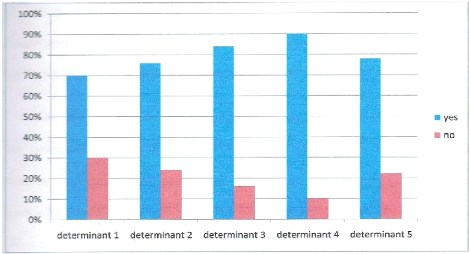
57
Figure 1: Distribution of the determinants of
the Amazigh heritage
The great majority of Chenini Berber speakers think that their
Amazigh culture is present in everyday life and in Tunisian society as well
(70%-76%). Although Chenini Berber inhabitants speak their Berber language very
frequently in their daily life, their language is not preserved. this is due to
the fact that the number of Berberphones has dramatically decreased. In fact,
this is an exception among Berber native speakers because some Arabized Berbers
view their language as a «stigma».
It appears that the number of Berbers who favor the widespread
of their Amazigh culture reaches eighty three percent. This reality supports
the fact that Chenini Berber speakers sought the promotion of their language,
for no culture can deny its historical roots. For this particular reason,
Chenini Berber inhabitants propose that Berber cannot disappear even if it
remains uncodified or untaught because it is their mother tongue.
The fact that Berber language is oral makes it difficult to be
recognized by the constitution. According to AbdelMassih (1971: xiii), «It
is this lack of
58
written documents that makes the tracing of the history of the
language somewhat difficult». Thus, if the Berber language and culture are
to be kept alive and developing, oral and written traditions should be fully
integrated so that one can inspire the other. Setting up a writing system is
part of language development and promotion. In Tunisia, this reality remains
difficult to attain since the Republic of Tunisia does not officially recognize
any indigenous ethnolinguistic minority within its borders.
Despite this, Chenini Berber speakers strongly agree about the
recognition of their Amazigh heritage and language in Tunisian society because
they are fully aware that this consolidates the status of their Berber
language. The fact which motivates Berber speakers is perhaps their awareness
that mother tongue education is an essential part of the move toward ensuring
its primary role of enculturation. As such, starting with the learner's native
tongue plays a crucial role in opening up progressively to the official
language and to the foreign languages, which are no doubt needed for
understanding today's unfolding world.
In addition to their mother tongue, Chenini Berbers sought to
learn Arabic. For some Chenini Berber speakers' facility in the lingua franca
is not as much a matter of prospering but of existing (Romaine, 1992: 92). The
crux of the matter then rests in the parents' perception of prospering and what
languages are necessary for access to the prosperous lifestyle. One of the most
common factors that leads a community to shift from one language to another is
that the acquired language is thought economically beneficial by its adoptive
community of speakers While visiting Chenini, I noted that the majority of
adult population left the village for Tataouine sometimes between 6:00 and 8:00
am and then returned between 4:00 and 6:00 pm. the same day. Those who remained
behind are the very old and the children enrolled at the community school
nearby.
59
Another significant factor is the reported fact that these
trips to Tataouine and back occurred seven days a week. For all intents and
purposes then, Chenini seems to function like a suburb to the city, Tataouine.
The lingua francas in Tataouine are «Shilha» and Tunisian Arabic. The
shift of allegiance from one variety to another is not surprising, particularly
among the many who spent their days in Tataouine. This refers to the strong
position of Chenini Berber speakers along an urban-rural-continuum.
In sum, position on the urban-rural continuum covers not only
the physical location of a speech community relative to an urban area, but also
what access speakers of the vernacular have to urban communities. They are
dependent upon a cash economy for their subsistence. To access this cash
economy, facility in at least one language is necessary. That is why Chenini
Berbers are encouraged to learn Arabic.
Part two of the questionnaire addresses issues related to
responses and attitudes toward Berber and the motives behind Tunisian
Arabic-Berber code switching. The findings reveal that Chenini Berber
participants alternate their codes according to the domain and the topic of the
conversation. The discussion of the implication of code switching according to
the two variables is made in relation to the percentages provided in tables 2
and 3 in the findings section above.
4.3.1 Participants' performance per domain
Chenini Berber speakers choose which language to use every
time they interact within a given domain. In this regard, Fishman (1972: 442)
defines a domain as «a sociocultural construct abstracted from topics of
communication, relationships between communicators, and locals of
communication, in accord with the institutions of a society and the spheres of
a speech community».
60
The cumulative choices then suggest which of the languages in
the community's repertoire is that the language of choice for each domain.
Home, where the vernacular is used but is mixed with an outside lingua franca
or other local language, is the first social domain throughout Chenini Berbers.
Another intimate domain which leads to shift in language allegiance is that of
the friendship domain. Figure 2 below reveals the distribution of the languages
chosen per domain:
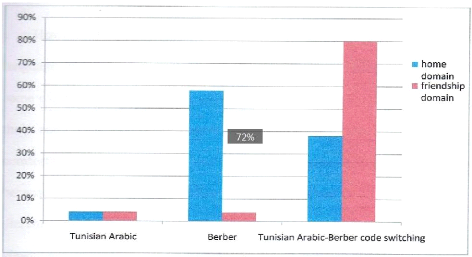
Figure 2: Distribution of the instances of
Tunisian Arabic-Berber code switching per domain
Regarding the code switching habit, the majority of Chenini
Berber speakers alternate their codes in the friendship domain more than in the
home domain. Speakers are expected to freely switch codes with their friends
especially those with whom they are more acquainted. Others prefer to speak
Berber language but not Tunisian Arabic at home, because this latter does not
represent their culture and belonging but they still need this variety. Giving
the
61
fact the whole family can understand and speak Berber, it is
not surprising that the language of interaction is Shilha. As such, Tunisian
Arabic remains the least favored language by a small minority of Chenini Berber
speakers especially among educated Chenini Berbers.
However, this does not entail that all Berber speakers tend to
speak Berber language in all the cases; instead it shows only that participants
always have some expectations toward their addressee. That is, speakers do the
majority of their code switching with people with whom they are most familiar
and comfortable. In other words, the speaker may choose to alternate his code
because he is talking with a close fiend. This view is alluded above in the
literature by Kim-Renaud (1986), who argues that «code switching may be
viewed as a reflection of the social relationship between speaker and
addressee».
This results in speech convergence, when speakers become more
alike in the language they use. When interlocutors become more similar in the
codes they use there would be greater liking between them. In addition,
research has shown that linguistic convergence is likely to increase
interlocutors' intelligibility, predictability and interpersonal involvement.
For instance, when a Chenini Berber speaker converges to the addressee's
language, the mechanism of language approval is communicated.
In fact, this reality supports what Communication
Accommodation theory Interlocutors' needs for social integration and social
approval. That is to say, Chenini Berber speakers switch to Tunisian Arabic
when they interact with an outsider who does not share the same code, namely
Berber. This largely supports convergence, i.e. «a speaker will choose a
language or a variety that seems to suit the needs of the person being spoken
to» (Fasold, 1987: 188).
However, there are even exceptions among Chenini Berber
speakers who do not speak Berber even though they are at home. This is largely
done in cases
62
where the mother cannot speak Berber or simply she is not from
Chenini or douiret, for instance. Another reason which may explain the
avoidance of Berber usage at home is attested among Chenini educated people,
who cannot see the practical benefits of Berber. They think that conserving
Berber «will not help you to earn your daily bread».
To better visualize the discrepancy between Tunisian
Arabic-Berber code switching in the two domains, we can draw the following
diagram:
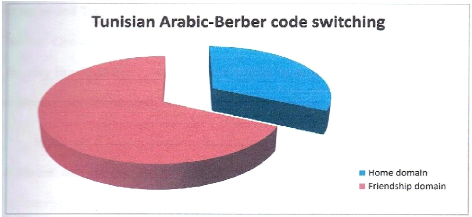
Up to this point, we can state that the phenomenon of code
switching is not resorted to following the same pattern in the two settings. In
the friendship domain, participants switch between codes more freely than in
the home domain. Hence, code switching is conditioned by the domain of the
conversation.
Linguists such as Bloom and Gumperz (1972:424) have stressed
the role of situational CS as one type of code switching which «involves a
direct relationship between language and the social situation [...] and
involves clear changes in the participants' definition of each other's rights
and obligations. On
63
the other hand, Fishman's (1972) definition of situational
code switching differs slightly. For him, situational CS is involved when
speakers switch codes according to the setting. For instance, a native Berber
speaker may speak Berber at home and Tunisian Arabic in the street or with
friends who do not understand berber. One might argue that this individual
behaviour would have an impact on the way in which Berber and Tunisian Arabic
have come to symbolize different cultures and conflicting lifestyles.
However, it should be noted that although Berber continues to
be spoken in different settings such as the street and the home, Chenini Berber
speakers encourage their children to learn Arabic for integrative and
instrumental purposes so as to be successful in school and in the other market.
In Chenini, code switching tends to be an urban phenomenon in the sense that
code switchers are usually educated city dwellers. In other words, Chenini
Berber speakers who migrate to urban areas such as Tataouine or Tunis switch
between Tunisian Arabic and Berber more than those Berber speakers who stay in
Chenini, a rural area. In Chenini, native Berbers speak in Berber in the
majority of cases.
Chenini Berber code switchers differ in their competence in
the two languages concerned (Tunisian Arabic and Berber). There are different
types of code switchers depending on the languages they switch to, their
gender, their linguistic ability and the topics addressed (Sadiqi, 2003).
However, we cannot state that Berberophones are all balanced bilinguals because
similar degrees of proficiency in the two languages are difficult to attain. It
is relevant to state then that Tunisian Arabic-Berber bilingualism in rural
areas is a case of «coordinate bilingualism because Berber is predominant
in the street, at home, in the shop and during social gatherings. By the same
token, Chenini Berber speakers are «folk bilinguals» whose own
language (i.e., Berber) does not have a high status
64
In the dominant language society with Arabic been the official
language in Tunisia.
In addition, the great majority of Chenini Berber children who
are learning Arabic before attending their schools may be labelled
«subtractive bilinguals» Because their L2 was learned at the expense
of losing their L1 in the sense that many words become arabized. To make it
clear, the young generation's interest about their Berber language is
decreasing contrary to old people who speak Berber frequently and fluently.
Berber is associated with female domains. There are four
important reasons for this. First, Berber is neither linked to religion,
literacy, nor politics. In other words, the fact that Berber is not codified
and remains unrecognized by the constitution. Second, the fact that it is an
oral language and a mother tongue makes it closer to women than to men. Third,
Berber is spoken by a large population of rural illiterate women. Fourth, it is
women who first speak the language to their children, and who have transmitted
it from generation to generation.
In addition to the setting domain variable discussed above,
participants tend their codes according to the topic of the conversation. This
variable is discussed in what follows.
4.3.2 Participants' performance per topic
Along with the domain variable referred to in section 4.3.]
above, mm. under study tend to switch their codes according to the topic of the
conversation. The topics discussed are home matters, religion, intellectual
life and everyday trade. Chenini Berber speakers tend to assign for each topic
one specific variety. For example, they all agree that in discussing religious
matters; only Modem Standard Arabic is involved because it is the language of
the holy book, i.e. the Q'uran. Berber people who tend to mix their codes think
that Tunisian Arabic-
|