Abstract
The world is currently under threat from the coronavirus
disease pandemic (COVID-19) caused by the SARS-CoV-2 virus. A very virulent
virus that has made COVID-19 a fatal disease, which targets the human
respiratory system. Newly identified from Wuhan,(China) this disease received
worldwide attention as early as december 2019. The world now registers more
than 218 million cases and Cameroon registers more than 84,000 infected cases.
In epidemiology, mathematical models are used to better understand the dynamics
of infectious diseases. In this work, we built a mathematical model of the
dynamics of disease transmission taking into account social distancing and
wearing face mask. The said model takes the form of a system of ordinary
differential equations. We examine the impact of these two measures on the
dynamics of COVID-19 in Yaoundé and Douala (Cameroon). We use the
available data, we seek to develop a predictive tool for the cumulative number
of reported disease cases. Using Lyapunov functions, we calculate the basic
reproduction number of the virus. Our theoretical results are confirmed by
mumerical simulations of the model. It is shown that if at least 50 % of the
population complies with the regulation of these various non-pharmaceutical
measures, the disease will eventually disappear in the population.
Keywords: COVID-19, SARS-CoV2, Lyapunov function,
social distancing, face mask.
xiii
Résumé
Le monde est actuellement sous la menace de la pandemie de
maladie à coronavirus (COVID-19) causée par le virus SARS-CoV2.
Ce virus très virulent qui a fait de la COVID-19 une maladie mortelle,
qui cible le système respiratoire humain. Nouvellement identifiée
en provenance de Wuhan, en Chine cette maladie a fait l'objet d'une attention
mondiale dès Décembre 2019. Le monde enregistre de nos jours plus
de 219 millions de cas infectés et le Cameroun quant à lui
enregistre plus de 94 000 cas. En épidémiologie, les
modèles mathématiques sont utilisés afin de mieux
comprendre la dynamique des maladies infectieuses. Dans ce travail, nous
construisons un modèle mathématique de dynamique de transmission
de la maladie avec distanciation sociale et port de masque facial. Le
modèle se présente sous la forme d'un système
d'équations différentielles ordinaires. Nous examinons l'impact
de ces deux mesures sur la dynamique de la COVID-19 à Yaoundé et
Douala au Cameroun. En utilisant les données disponibles, nous
développons un outil prédictif pour le nombre cumulé de
cas des maladies signalés. Grâce aux fonctions de Lyapunov, nous
calculons le nombre de reproduction de base du virus. À l'aide des
simulations numériques du modèle, nous montrons que si au moins
50% de la population se conforme à la réglementation de ces
diverses mesures non pharmaceutiques, la maladie finira par disparaître
dans la population.
Mots clés : COVID-19,
SARS-CoV2, fonction de Lyapunov, distanciation sociale, masque
facial.
1
GENERAL INTRODUCTION
Departing from China to Wuhan on December 31, 2019 [1, 2],
the coronavirus epidemic quickly spread around the world. After three months of
the pandemic, 185 countries were affected [3]. As of April 12, 2020, the world
had recorded 1.9 million confirmed cases. Cameroon is one of the most affected
countries in Africa, with nearly 82,064 confirmed cases as of August 31,
2021[4]. COVID-19 is a highly contagious disease, and the strain is the
SARS-CoV-2 . Coronaviruses are a family of viruses, some of
which can infect humans, most often causing mild cold-like symptoms. However,
three deadly epidemics have already occurred in the 21 st century, including
the current one. They involve emerging coronaviruses harbored by animals and
suddenly transmitted to humans: SARS-CoV and MERS-CoV. When
the epidemic linked to the coronavirus SARS-CoV-2 spread
around the world, research is mobilized to accelerate the production of
knowledge on this virus, on the disease it causes (COVID-19 ) as well as how to
cure and prevent it. Our interest in this mysterious disease will thus be
heightened. We need to learn more about this disease in order to assess the
real threat it represents. We will then observe the evolution of the disease
after having introduced the parameters of social distancing and wearing of a
face mask in a mathematical model built on the basis of the dynamics of
transmission of the disease proposed very recently by Nkamba et al [5]. This
model takes the form of a system of nonlinear ODEs.
The novelty of this study lies in the theoretical proof of
the existence of endemic equilibrium and specific predictions for the city of
Yaoundé and Douala in Cameroon. This is why to claim a certain
exhaustiveness, the work will revolve around three main chapter :
· The chapter I will be devoted the generalities of
COVID-19, we present the history on the coronavirus, the origin of SARS-CoV-2,
the symptoms of COVID-19, its mode transmission, course of virus infection,
diagnosis of COVID-19, means of prevention and treatment.
· In chapter II, we present the mathematical model on
which we calculate the basic reproduction
LIST OF TABLES 2
Master's thesis II * Molecular Atomic Physics and
Biophysics Laboratory-UYI * YAMENI STEINLEN DONAT D
(c)2021
number Rc,we also investigate asymptotic
stability of the disease-free equilibrium.
· The chapter III will be devoted to the numerical
results obtained within the framework of this work while discussing on their
biological implications.
We will end our work with a general conclusion in which we
will summarize our work and open some perspectives.
CHAPTER I
GENERAL INFORMATION ON
COVID-19
3
1.1 Introduction
An outbreak of pneumonia cases of unknown origin erupted in
the city of Wuhan in China at the end of December 2019. Chinese health
authorities quickly notified the World Health Organization (WHO). The pathogen
in question is identified at the beginning of the month of January 2020 as
being the new Coronavirus called SARS-CoV- 2. Indeed, the Coronavirus is a
large family of pathogenic viruses that can cause simple illnesses such as the
common cold but also serious illnesses such as Severe Acute Respiratory
Syndrome (SARS-CoV), Middle East Respiratory Syndrome (MERS-CoV), and the most
recent, Coronavirus disease (COVID-19). The latter very quickly became a global
pandemic, having already caused more than a million deaths worldwide [6]. In
this chapter, it is a question for us of approaching the generalities on the
disease with Coron-avirus in this case its history, origin, its symptoms, the
mode of transmission, course of its infection, causes, consequences, treatment
and prevention in order to limit the spread of Coronavirus disease.
1.2 History of the coronavirus
Coronaviruses (Cov) form a huge family of viruses with an
extremely long RNA genome (several thousand nucleotides).
There are many subtypes of coronavirus that infect different
animal species. Man can host at least five, of which the most common are
HCoV-229 and HCoV-OC43 [7]. Very common,
these viruses are associated with colds and mild flu-like symptoms. It can also
infect humans without
1.2. HISTORY OF THE CORONAVIRUS 4
Master's thesis II * Molecular Atomic Physics and
Biophysics Laboratory-UYI * YAMENI STEINLEN DONAT D
(c)2021
triggering symptoms or, conversely, be involved in respiratory
complications such as pneumonia in immunocompromised people or infants.
This virus is easily transmitted from man to man by air, in
contact with secretions or that of contaminated objects, particularly in
winter. The incubation period preceding the onset of symptoms lasts 03 to 06
days and the treatments, if necessary, are symptomatic (treatment of fever,
possible pain). However, coronavirus infections are usually not diagnostic due
to their mild nature and spontaneous recovery.
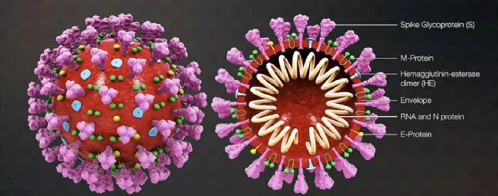
Figure 1.1: Structure of the covid 19 virus
[8].
1.2.1 The Severe Acute Respiratory Syndrome Coronavirus
Outbreak (SARS-CoV)
SARS-CoV is the first Coronavirus to cause serious illness in
humans. It was rampant in epidemic form between November 2002 and July 2003.
More than 8, 000 cases have been identified in 30 countries and 774 people have
died. The epidemic started with a few cases in Guangdong province, southeast
China, following the consumption of infected civets. These cases then triggered
a chain of human-to-human transmission. Several cases occurred in different
cities around Guangzhou, then the virus was introduced in Hong Kong in February
2003. It then spread to Vietnam, Singapore, Canada, the Philippines, the United
Kingdom or the United States following the movement of infected people. It has
been possible to establish a link between more than half of the infections and
a single patient who arrived in Hong Kong on 21 February 2003 [7]. The
1.2. HISTORY OF THE CORONAVIRUS 5
Master's thesis II *
Molecular Atomic Physics and Biophysics Laboratory-UYI
* YAMENI STEINLEN DONAT D
(c)2021
epidemic was controlled thanks to a global alert triggered on
March 12, 2003 by the World Health Organization, the cessation of consumption
of civets in China, the early warning of suspected cases, the isolation of
patients from the start. First symptoms, the care of people with whom they had
been in contact and the protection of caregivers.
1.2.2 The Middle East Respiratory Syndrome
Coronavirus Outbreak ( MERS-CoV)
The first case of infection dates back to 2012, in Saudi
Arabia when a 60-year-old man died of progressive respiratory and kidney
failure eleven days after being admitted to hospital. The patient had a history
of fever, cough, and respiratory failure for seven days. In September of the
same year, the case of a 49-year-old man from Qatar was reported in a hospital
in London. He presented with pneumonia and renal failure, a new series of
samples taken from the same patient revealed a positive MERS-CoV infection. In
retrospect, the infection was found in a respiratory sample from a Near Eastern
country, Jordan, where in April 2012 a respiratory epidemic occurred in a
public hospital. This shows at leisure how the virus can spread with a certain
ease, passing from one country to another [6, 7]. Human-to-human transmission
occurs by air, via airborne droplets without air. But the virus is weakly
transmissible. Nevertheless, a patient in South Korea is at the origin of 154
contaminations. The World Health Organization is actively monitoring the spread
of the virus and identifying new cases in order to regularly update the list of
affected countries. At present, no specific treatment or vaccine is available
against this virus which strikes more people who are immunocompromised or
suffering from chronic pathologies (diabetes, renal failure, chronic pulmonary
infection, etc...).
1.2.3 The Coronavirus disease pandemic (COV
ID - 19)
The SARS-CoV-2 belongs to the family of coronaviruses (CoV),
name linked to the "crown" formed by certain proteins on the surface of these
viruses. It was first identified in Wuhan, China, in Dec 2019 Several
coronaviruses are already known to be able to infect humans: three seasonal
coronaviruses responsible for mild winter symptoms (colds), SARS-CoV
responsible for the syndrome severe acute respiratory (SARS) and MERS-CoV
responsible for potentially severe respiratory damage (Midale East Respiratory
syndrome). SARS-CoV-2 is the seventh human pathogenic coronavirus. It is
responsible for the disease Covid-19 (Coronavirus Disease 2019) SARS -CoV-2
1.3. ORIGIN OF SARS-COV-2 6
Master's thesis II * Molecular Atomic Physics and
Biophysics Laboratory-UYI * YAMENI STEINLEN DONAT D
(c)2021
is a virus with RNA envelope whose genome (30 kilobases) codes
for 15 genes therefore 04 corresponding to structural proteins: one surface
protein (spike or S protein), a membrane protein (M), an envelope protein (E)
and a core protein (N) this genome has 79% homology with SARS-CoV and 52%
homology with MERS-CoV. The coronavirus to which it is phylogenetically closest
is Ra TG13-CoV, a coronavirus that infects bats (96% homology)
[7].
|