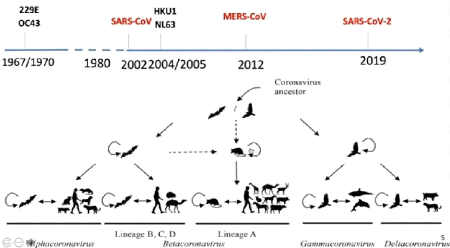
The origin of SARS-CoV-2 is not fully understood.
Particularly common in some animals, the coronavirus only occasionally crosses
the species barrier to infect humans. There are exceptions, however, such as
SARS-CoV which was accidentally transmitted to humans through consumption of
masked civets and MERS-Cov through camels. SARS-CoV-2 is genetically closer to
viruses that infect bats than MERS-CoV or SARS-CoV.
But, so far no direct viral transmission has been described
between this species and humans. This is why researchers believe it is likely
that transmission to humans has occurred through an intermediate host species
[7]. The pangolin was initially identified as a carrier of a coronavirus
similar to SARS-CoV-2, however several elements leave this possibility
doubtful, particularly because the genetic sequences of the virus responsible
for the current epidemic and that of the coronavirus which infects the pangolin
conserved significant differences. Two hypotheses remain:
· The virus would have been transmitted from bats to
humans via an animal species not yet identified.
· The virus is believed to have circulated in humans for
several years, quietly until a recent mutation made it more virulent and
pathogenic.
1.4. SYMPTOMS OF COVID-19 7
Master's thesis II * Molecular Atomic Physics and
Biophysics Laboratory-UYI * YAMENI STEINLEN DONAT D
(c)2021
Figure 1.2: Zoonotic cycle emergence of
Coronaviruses.
1.4 symptoms of COVID-19
People infected with COVID-19 may have very mild or no symptoms
or, on the contrary, a
serious illness or death. Most infections are usually mild and
their symptoms gradually appear 2
to 14 days after exposure to COVID-19. Among the most common
symptoms are
* A dry cough,
* Fever,
* Fatigue,
and among the other existing symptoms:
V Pain,
V The runny nose,
V Sore throat.
However, some people develop serious breathing problems, heart
rhythm disturbances, heart
damage and shock as a result of the infection. The risk of dying
from COVID-19 is higher for some
populations, including adults aged 65 and over (risk increases
with age), people with underlying
chronic diseases (especially heart disease , diabetes and lung
disease) and people with weakened
immune systems.
1.5. TRANSMISSION MODE 8
Master's thesis II * Molecular Atomic Physics and
Biophysics Laboratory-UYI * YAMENI STEINLEN DONAT D
(c)2021
1.6. DIAGNOSIS OF COVID-19 9
Master's thesis II * Molecular Atomic Physics and
Biophysics Laboratory-UYI * YAMENI STEINLEN DONAT D
(c)2021
1.7. COURSE OF VIRUS INFECTION 10
Master's thesis II * Molecular Atomic Physics and
Biophysics Laboratory-UYI * YAMENI STEINLEN DONAT D
(c)2021
1.8. PREVENTION AND TREATMENT 11
1.9. CAUSES OF COVID-19 12
Master's thesis II * Molecular Atomic Physics and
Biophysics Laboratory-UYI * YAMENI STEINLEN DONAT D
(c)2021
1.5 Transmission mode
SARS-CoV-2 is transmitted from an infected person to an
uninfected person by two main routes:
V Direct contact with the infected person or a
surface they have contaminated
V Aerial (or airborne) transmission of the virus via
droplets or aerosol emitted by the infected person.
Droplets (1 mum) are emitted from our
mouth and nose when we speak, shout, sing, cough or sneeze. Aerosols are
suspensions of smaller particles (a few nanometers at 100
mum), like the vapor produced by our breathing in cold
weather. There is in reality a continuum between droplets and aerosol which in
practice renders the distinction between these two modes of vectorization of
the [7] virus artificial. Concretely, in the absence of a mask, an infected
person emits droplets loaded with viruses, the most serious of which on
surfaces in the immediate vicinity. A healthy person can then become infected
by touching the contaminated area with their hands and then bringing them to
their mouth, nose or eyes. The virus can persist for several hours on a
contaminated inert surface. The duration of the surface, the surrounding
temperature, humidity and light conditions. But that's not all: the smaller the
diameter of the droplets emitted by the infected person, the more these
droplets can be carried away by the ambient air and remain in suspension there.
The virus can thus accumulate in the indoor air of a poorly ventilated room and
lead to its airborne transmission.
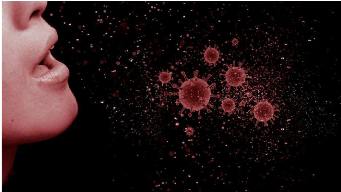
Figure 1.3: respiratory droplets given off when a
person sneezes [9].
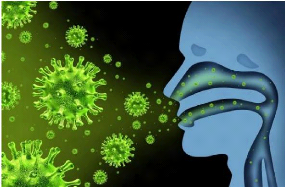
Figure 1.4: Evolution of the virus in the respiratory
tract [9].