1.6 Diagnosis of COVID-19
If you have symptoms of COVID-19 infection, see a doctor.
Your health care provider will ask you to describe your symptoms, your travel
history, and whether you may have been in contact with someone with COVID-19.
Coronavirus infections are diagnosed by a health care provider based on
symptoms and are confirmed by a lab test. The test is usually done through a
nasal swab or a throat swab.
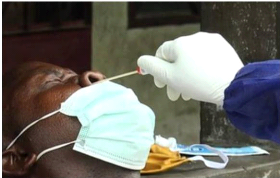
Figure 1.5: nasal swab [10].
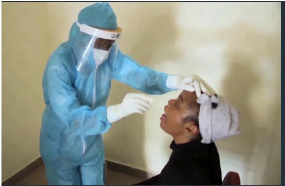
Figure 1.6: saliva sample [10].
1.7 Course of virus infection
The virus enters the body through the airways, from the nose
and mouth. Part of its surface protein (the RBD region of S protein);
binds to the ACE-2 receptor expressed on the surface
of cells that line our airways. Another cellular protein (TMPRSS2) then allows
the virus to enter the cell. Once inside, it uses the host's cellular machinery
to multiply there. New virions are formed and will infect new cells.
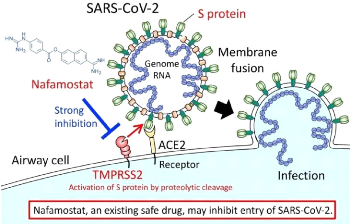
Figure 1.7: Course of virus infection.
Master's thesis II * Molecular Atomic Physics and
Biophysics Laboratory-UYI * YAMENI STEINLEN DONAT D
(c)2021
1.8 Prevention and Treatment
Most people with a mild form of the disease will recover
without treatment. However, your health care provider may recommend certain
medications or therapies that are available to provide comfort and relieve
symptoms of COVID-19. Drug treatments to treat COVID-19 are currently under
development and testing. On July 27, 2020, Health Canada approved remdesivir
(Veklury) to treat severe symptoms of COVI-19 in adults and adolescents 12
years of age and older, who weigh at least 40 kg[11].
Since COVID-19 is primarily transmitted from person to
person, practicing good hand hygiene is one of the most important things you
can do to avoid getting infected. Whenever possible, wear a non-medical face
mask as the virus can remain in the air, Maintain physical distances of at
least one meter from a third party. Avoid touching your eyes, nose and mouth
with dirty hands. You should try to minimize your risk of exposure to the virus
by avoiding contact with sick people. If you are sick, you should cover your
nose and mouth when you sneeze or cough. The first COVID-19 vaccines hit the
market barely a year after the discovery of the Coronavirus SARS-CoV-2 causing
the pandemic. Cameroon received 200,000 doses of the SINOPHARM vaccine on April
11, 2021, and the first vaccinations were done the following day. On April 17,
2021, it is around the ASTRAZENECA vaccine to set foot on the soil of
Cameroonian territory.
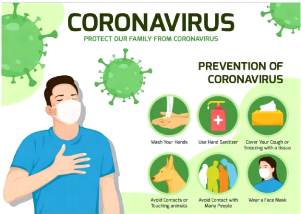
Figure 1.8: Prevention.
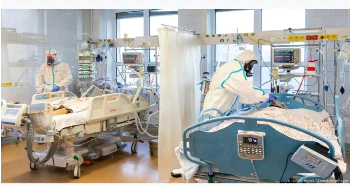
Figure 1.9: Treatment[11].
1.9 Causes of COVID-19
The virus that causes COVID-19 is officially known as
SARS-CoV-2 (Severe Acute Respiratory Syndrome). It belongs to a larger family
of viruses called the coronavirus. Although coronaviruses can affect both
animals and humans, only human coronaviruses are known to cause respiratory
infections. These infections can be mild illnesses like the common cold but
also serious illnesses like Severe Acute Respiratory Syndrome (SARS) and Middle
East Respiratory Syndrome (MERS) [11].
The spread of COVID-19 is not completely clear, but
investigations have found that the outbreak may have started in an animal
market. COVID-19 may not be spread from person to person through respiratory
droplets. You can also come into contact with the virus through aerosols
(droplets small enough to float in the air) if an infected person coughs or
sneezes near you. These aerosols remain in the air for long periods of time.
You can also get the virus by touching your eyes, nose or mouth. The following
people are at high risk of exposure:
· People who live in areas of high COVID-19
transmission,
· People in close contact with people with COVID-19,
· Healthcare workers caring for patients with COVID-19,
· People who do not follow public health measures (for
example, wearing a mask, washing their hands),
·
1.10. CONSEQUENCES ON COVID-19 13
Master's thesis II *
Molecular Atomic Physics and Biophysics Laboratory-UYI
* YAMENI STEINLEN DONAT D
(c)2021
Travelers returning from affected international locations
(including cruise ships, conferences).
|