2.2 Theoretical review
In a study by Waruiru et al. (2014) on factors associated with
HIV discordance among couples in Kenya, data from the 2012 Kenya AIDS Indicator
Survey (KAIS) were analyzed. This population-based survey included individuals
aged 18 months to 64 years, collecting demographic and behavioral information
along with blood samples for HIV testing. The analysis focused on married or
cohabitating couples with available HIV test results for both partners.
Logistic regression was used to identify factors associated with HIV
discordance, selecting variables with a p-value of 0.10 or lower in
bivariate analyses for the final multivariable model. The analysis accounted
for the sampling design and non-response, with population estimates of HIV
discordant couples calculated using un-normalized survey weights.
Out of a total of 4,226 couples, 2,032 couples (which is
48.1%) completed both interviews and HIV tests. Among these tested couples, the
majority, 92.0% (1,870 couples), had both partners testing HIV-negative,
indicating they were HIV concordant. A smaller percentage, 3.2% (65 couples),
had both partners testing HIV-positive, meaning they were also HIV concordant
but with both partners positive. The remaining 4.8% (97 couples) were HIV
discordant, meaning one partner was HIV-positive while the other was
HIV-negative. This proportion of discordant couples translates to approximately
260,000 couples in the broader population.
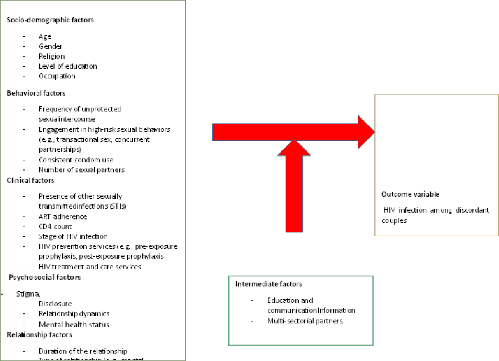
2.4 Conceptual-framework
INDEPENDENT-VARIABLES DEPENDENT-VARIABLES
17
Figure 1:Conceptual framework on the prevalence of
HIV discordance and associated risk factors among couples receiving HIV test
(Source: The researcher, 2024)
18
CHAPTER3:METHODOLOGY
3.1 Studysetting
The study was conducted in Kibagabaga Hospital, located in
Gasabo District. Kibagabaga Hospital is a prominent healthcare facility
providing a wide range of medical services to the local population and is
well-regarded for its commitment to improving public health. The Hospital has a
comprehensive program for HIV testing and treatment, making it an ideal setting
for this research. Gasabo district, situated in Kigali, the capital city of
Rwanda, has a diverse population with varying socioeconomic backgrounds,
providing a rich context for investigating the prevalence of
3.2 Research design
This approach provided empirical evidence to inform targeted
interventions aimed at reducing HIV transmission among couples in the Hospital
setting.
3.3 Study population
According to Sparks & Joyner (2019), a population is the
total collection of elements about which we wish to make inferences. The target
population in this study was comprised of 96 discordant couples who attended
Kibagabaga Hospital of Gasabo District, during the period of 2020-2024.
19
3.4 Sample size
Records from Kibagabaga Hospital showed a total number of 696
discordant couples from 2020 to 2024. N
n =
1 + Ne2
Formula for determination of Sample Size, n (Yamane,
1967); Where: n= the sample size
N = the population size
e= the desired level of statistical significance (0.05)
Therefore.
|
n=
|
N
1+Ne2
|
696
|
=254
|
|
1+696(0.05)2
|
|
Hence, this study will recruit 254 discordant couples to
participate.
|