|
English Language Integration in the Algerian Context: The Shift from French to EMI in Higher Education The Case of the Institute of Science and the Institute of Technology at Naama University Centrepar Bachir&Linda BOUARAF&AMRANI Naama-Algérie - Master en Langue Anglaise 2025 |

PEOPLE'S DEMOCRATIC REPUBLIC OF ALGERIA MINISTRY OF HIGHER EDUCATION AND SCIENTIFIC RESEARCH AHMED SALHI UNIVERSITY CENTRE-NAAMA
INSTITUTE OF LETTERS AND LANGUAGES DEPARTMENT OF ENGLISH
English Language Integration in the Algerian Context: The Shift from French to EMI in Higher Education The Case of the Institute of Science and the Institute of Technology at Naama University Centre A dissertation Submitted to the Department of English as a Partial Fulfillment of the Requirement of Master Degree in Linguistics Presented by Supervised by: Mr. Bachir BOUARFA Mrs. Linda AMRANI Dr. Hayat BAGUI Board of Examiners: Dr. FATMI Fayçal President Namma University Centre Dr. BAGUI Hayat Supervisor Namma University Centre Dr. MERINE Asma Examiner Namma University Centre Academic Year: 2024/2025 Dedication Praise be to Allah, by whose grace good deeds are accomplished. I indebt everything to my Country. I indebt everything to my Parents. I indebt everything to the People's National Army. I indebt everything to my Family. To them I dedicate this humble work. I BACHIR BOUARFA II Dedication To the one who planted in my heart a love for life, and
whose sincere prayers To the first pillar of support in my life, whose
encouragement guided me To my life partner, who shared my dreams and stood by me in
every moment, to To the heartbeat of my life and the reason behind my joy, to my beloved children, you are my endless motivation and the happiness behind every achievement. To those who supported and helped me without hesitation or weariness, to my cousin Salima and my relative Rania, thank you for your kind hearts, your precious time, and your generous presence. To everyone who supported me with a kind word, a prayer, or a sincere smile, to all members of the families: Amrani, Amara, and Belaimche I extend my deep respect and gratitude. Your presence in my life is a priceless blessing. To all of you, I dedicate this humble thesis as a token of love and appreciation, and as a reminder that success is never achieved alone, but with the support of those who truly believe in me. AMRANI LINDA III Acknowledgements With deep respect and appreciation, we express our heartfelt thanks and gratitude to everyone who supported and accompanied us throughout our academic journey, and who, after the grace of Almighty Allah, had a role in the completion of this thesis. First and foremost, we would like to begin by expressing our sincere gratitude to our esteemed thesis supervisor Dr. BAGUI Hayat, who has been a true guide and mentor. For the trust she placed in us, the freedom she granted us in completing this work, as well as for her encouragement and constant support. We express our deepest respect and gratitude for her patience, dedication, and valuable guidance. We would also like to extend our sincere thanks and appreciation to the honorable thesis defense committee, Dr. FATMI Fayçal and Dr. MERINE Asma, for their precious time, constructive feedback, and valuable contributions in evaluating this work. We would like to express our sincere thanks to all the academic and administrative staff of the English Department, especially the teachers who have marked our journey with their dedication, commitment and guidance to enable us to accomplish such a work. Finally, we would like to express our deep gratitude to all the professors and students at the Institute of Science and the Institute of Technology at Naama University Centre; who kindly answered our questions and enriched this research with their ideas, opinions, and perspectives. Without their participation, this work would have been pointless. IV AbstractThe adoption of English as a Medium of Instruction (EMI henceforth) in Algerian higher education remains a subject of considerable interest and ongoing debate. This study aims to assess the first academic year of the transition from French to EMI in Algerian universities. It examines teachers' perspectives on the shift, students' attitudes, and their capacity to assimilate knowledge while studying in English. Additionally, the research explores staff and equipment challenges facing this shift. A mixed-method descriptive approach was employed, combining quantitative data collected through a questionnaire administered to 89 students from the Institute of Science and the Institute of Technology at Naama University Centre, and qualitative insights gathered through interviews with 12 teachers from the same institutes. The study seeks to provide an in-depth understanding of the transition's effectiveness by capturing the experiences and viewpoints of the main actors undergoing this transition: teachers and students. The study's findings provide persuasive evidence that the adoption of EMI is associated with considerable human and material challenges, particularly in terms of students' English language proficiency and teaching staff preparation. However, such challenges contrast with an apparent positive attitude toward EMI implementation and general optimism in its capacity to improve the Algerian higher education system. V Table of Contents Dedication I Acknowledgements III Abstract IV Table of Contents V List of Abbreviations and Acronyms VIII List of Tables IX List of Figures X GENERAL INTRODUCTION 1 CHAPTER ONE: LINGUISTIC REPERTOIRES AND ENGLISH STATUS IN ALGERIA 5 1.1. Introduction 5 1.2. Sociolinguistic Situation in Algeria 5 1.2.1. Historical Factors 5 1.2.2. Political Factors 8 1.2.3. Socio-cultural Factors 9 1.2.4. Socio-economic Factors 10 1.3. The Status of English in Algeria 11 1.3.1. English as a Global Language 11 1.3.2. English in Algerian Social Life 11 1.3.3. English in the Algerian Education System 12 1.4. English as a Medium of Instruction in Algerian Higher Education 12 1.4.1. English as Medium of Instruction 13 1.4.2. Linguistic Shift from French to English as Medium of Instruction 14 1.4.3. Teachers' Attitudes towards Introducing English as Medium of Instruction 15 VI 1.4.4. Students' Attitude toward the Shift from French to EMI 17 1.5. Conclusion 18 CHAPTER TWO: METHODOLOGY, DATA ANALYSIS AND INTERPRETATION 20 2.1. Introduction 20 2.2. Research Design 20 2.3. Research Instruments 20 2.3.1. Questionnaire 20 2.3.2. Interview 21 2.4. The Sample of the Study 22 2.5. Treatment of Data 24 2.6. Data Analysis 25 2.6.1. Questionnaire Analysis 25 2.6.2. Interview Analysis 44 2.7. Data Interpretation 53 2.8. Suggestions and Recommendations 55 2.9. Contribution to Knowledge 55 2.10. Research Limitations 56 2.11. Conclusion 57 GENERAL CONCLUSION 59 REFERENCES 62 APPENDICES 66 Appendix 1 : Loi n° 91-05 du 16 janvier 1991 portant généralisation de l'utilisation de la langue arabe. 66 Appendix 2 : Ordonnance no 96-30 du 21 décembre 1996 modifiant et complétant la loi no 91-05 du 16 janvier 1991 portant généralisation de l'utilisation de la langue arabe. 70 Appendix 3 : Interview for Teachers 72 VII Appendix 4 : Interview for Teachers (French) 74 Appendix 5: Questionnaire for Students 77 Appendix 6 : Questionnaire for Students (in Arabic) 81 VIII List of Abbreviations and Acronyms B2: Upper-Intermediate (English Proficiency) C1: Advanced (English Proficiency) CEFR: Common European Framework of Reference for Languages CNT: The National Transition Council- Conseil National de Transition EMI: English as Medium of Instruction ESP: English for Specific Purposes FFS: Front des Forces Socialistes-Socialist Forces Front
MSA: Modern Standard Arabic RCD: Rally for Culture and Democracy IX List of Tables
Table 2.6. Influence of EMI on Understanding and Assimilation of Knowledge 36 Table 2.7. Respondents' Opinions on the Benefits of EMI 38 Table 2.8. Respondents' Justification for the Opinions on the Benefits of EMI 39 Table 2.9. Respondents' Suggestions to Improve the Transition to EMI 42 X List of Figures
Figure 2.15. Influence of EMI on Understanding and Assimilating Knowledge 36 Figure 2.16. Effectiveness of Implementation of EMI 37 Figure 2.17. Respondents' Opinions on the Benefits of EMI 38 Figure 2.18. Respondents' Justification for the Opinions on the Benefits of EMI 39 Figure 2.19. Respondents' Suggestion to Improve the Transition to EMI 42 GENERAL INTRODUCTION 1 GENERAL INTRODUCTION English has become a global lingua franca. According to Encyclopaedia Britannica (2025), there are 1.27 billion English speakers worldwide as of 2020. This ranks it ahead of Hindi (637 million speakers) and Mandarin Chinese (1.12 billion speakers) as the most spoken language. English is; in fact, the first language of the majority of the population. It is spoken as a first language by approximately 375 million people and by over 750 million people as a second language. In addition, English has official or special status in nearly 70 countries. (Rao, 2019). This global spread of English has also had an impact on Algeria, where the language is becoming increasingly influential across various sectors. This language continues to gain prominence in all aspects of life. In addition to education, it is becoming more prevalent in other sectors of society such as economics, politics, tourism, and employment (Boukezzoula, 2016). The increased demand for English instruction has placed considerable pressure on the Algerian educational system. The recent decision to introduce English as a language of instruction in universities has generated many challenges for both students and teachers. As a result, Algerian higher education is therefore under pressure, resulting in overcrowded programs, a lack of resources, difficulties with language transfer within the teaching staff, and the need to manage the coexistence of three languages. To better understand the current linguistic dynamics in Algeria, it is essential to examine the historical phases that have shaped the country's sociolinguistic landscape. Influenced by historical, political, economic, and cultural factors, the Algerian's linguistic situation has gone through three major phases: pre-independence in 1962, post-independence until the end of the twentieth century, and then from the beginning of the twenty-first century until today. The first phase was characterized by the total hegemony of French, the colonial power's language. The second phase saw the confrontation between two languages: Modern Standard Arabic (MSA), imposed by the government of independent Algeria through a vigorous Arabization policy, and French, defended by French and Berber speakers. Finally, the 2 third phase is marked by an English breakthrough as a consequence of political, economic, and cultural mutations. This study aims; then, basically to evaluate the first academic year of the new experience of adopting English as a means of instruction in Algerian higher education. In addition, the study attempts to verify the influence of a change in language of instruction on the assimilation of knowledge, and the perception and attitude of teachers towards EMI. The researchers anticipated that this study would find answers to the following questions:
Based on the research questions, we hypothesize that:
To explore these hypotheses, this study adopts a systematic inquiry involving the key stakeholders of this educational reform. It tries to evaluate the new experience of introducing English as a means of instruction in Algerian higher education. It provides, through a mixed method, elements of objective evaluation taken from the main actors who participate in this new experience: students and teachers. 3 This research contains two chapters. The first chapter is theoretical in form. It reviews the literature about the sociolinguistic situation of Algeria, the status of English in Algeria, and the aspects related to the shift from French to English as a medium of instruction in higher education. The second is practical in form. It presents the study methodology, followed by the analysis and discussion of the finding. Finally, we will talk about the research limitations and its implications and contribution to knowledge. CHAPTER ONE: LINGUISTIC REPERTOIRES AND
ENGLISH 1.1. Introduction 1.2. Sociolinguistic Situation in Algeria 1.2.1. Historical Factors 1.2.2. Political Factors 1.2.3. Socio-cultural Factors 1.2.4. Socio-economic Factors 1.3. The Status of English in Algeria 1.3.1. English as Global Language 1.3.2. English in Algerian Social Life 1.3.3. English in the Algerian Education System 1.4. English as a Medium of Instruction in Algerian Higher
Education 1.4.2. Linguistic Shift from French to English as Medium of Instruction 1.4.3. Teachers' Attitudes towards Introducing English as Medium of Instruction 1.4.4. Students' Attitude toward the Shift from French to EMI 1.5. Conclusion 5 CHAPTER ONE LINGUISTIC REPERTOIRES AND ENGLISH STATUS IN ALGERIA CHAPTER ONE: LINGUISTIC REPERTOIRES AND
ENGLISH 1.1. Introduction The current chapter will review the literature on the Algerian linguistic landscape. It sheds light on the factors that have shaped the sociolinguistic situation in Algeria. It then stresses the recurring conflicts between French-speakers and Arabic-speakers over the Arabisation policy conducted after independence, as well as the polemical debates over the place of French in Algeria. It also discusses the status of English in Algeria. It finally reviews the previous studies dealing with the shift from French to English as medium of instruction in Algeria's higher education. 1.2. Sociolinguistic Situation in Algeria Algeria is a multilingual nation, and its turbulent past generates a complex linguistic situation (Benrabah, 2014). The Algerian people use one of these "languages" or a combination of them: Colloquial Algerian, Tamazight, Modern standard Arabic, and French. Algerian linguistic situation is both rich and complex. It distinguishes Algeria as a distinct Arab nation in terms of the number of languages taught and used in academic and non-academic contexts. Although this multilingualism is considered a sign of wealth, unfortunately, it generates endless ideological, socio-political, and even ethnic conflicts. Complexity and conflicts are the results of a number of historical, political, cultural, and socio-economic factors (Le Roux, 2017). 1.2.1. Historical Factors a) Frenchification Between 1830 and 1962, France, the colonial power, followed a methodical deracination and deculturization policy. To carry out its "civilizing mission," it imposed a total Frenchification assimilationist policy on millions of resistant Algerians (Gallagher, 1968, 132-133, as cited in Benrabah, 2014, p. 44). 6 CHAPTER ONE LINGUISTIC REPERTOIRES AND ENGLISH STATUS IN ALGERIA In the 1930s, the French government went so far as to pass legislation classifying Arabic as a foreign language and outlawing its usage in official papers and schools. Moreover, despite all efforts to make room for Arabic, French remained the dominant language, undermining the Arabic language's status and prestige (Maamri, 2009). When the Algerian people were able to get rid of the colonial yoke, independent Algeria inherited a very complex socio-cultural situation, described in these terms by Benrabah: By 1962, colonial France had dismantled the tribal structure completely. There were 10 million Algerians, a quarter of whom lived in towns, and less than one million non-Moslems who left the country. The illiteracy rate stood at around 90%, with only 5.5% (around 300,000) of the population literate in Literary Arabic only. As for competence in French, one million could read it and six million spoke it (2014, p. 46). As stressed by Maamri (2009), the authorities of post-independent Algeria saw the situation as follows: without re-establishing the foundation of that identity--the Arabic language--the Algerian society, whose identity had been suppressed for 130 years, could not start the process of reconstruction. Accordingly, they engaged in a policy of Arabisation aimed at restoring the place of the Arabic language within Algerian society. b) Arabisation Arabisation refers to the process by which the Algerian government imposed various decrees, laws, and ordinances in order to reinvent Algeria's Arab identity by forcibly imposing the once-prestigious Classical Arabic, which was artificially transformed into Modern Standard Arabic (MSA) (Belmihoub, 2012). Ahmed Ben Bella, the first Algerian president (1962-1965), initiated the Arabisation policy. It was a symbolic act because Algeria, at that time, lacked Arabic-speaking executives and teachers. It was Houari Boumedienne, Algeria's second president (1965-1978), who opted for a radical approach to Arabisation policy. He imposed the use of Arabic in the civil service, setting a three-year deadline for civil servants to master the language. The same thing happened in education, where Abdelhamid Mehri, the head of primary and secondary education, encouraged an increase in Arabisation after 7 CHAPTER ONE LINGUISTIC REPERTOIRES AND ENGLISH STATUS IN ALGERIA 1970. Prior to being included in the reform, higher education resisted for a little while longer (Maamri, 2009). While the 1980s witnessed an Arabisation policy without relief, the 1990s saw a resumption of an Arabisation policy in a context marked by major socio-political and economic changes. Two laws were passed in the 1990s: law No. 91-05 of January 16, 1991, which required the Arabisation of all government buildings, schools, institutions by July 5, 1992, and the total Arabisation of higher education by July 5, 1997. On December 22, 1996, The National Transition Council- Conseil National de Transition (CNT) adopted a second law, modifying and completing the previous law on the generalisation of the use of Arabic, in which deadline for higher education extended to July 5, 2000. Its stated goal was to challenge French dominance (Maamri, 2009). As a result, institutional Arabic now serves more purposes. In addition to the Ministry of Education, where de-Frenchification is almost complete, the Justice Ministry, the Ministry of Religious Affairs, and the town hall registry offices have all undergone some degree of Arabic conversion. Literary Arabic is the only language that is taught in primary, secondary, and university-level humanities programs in the educational sector (Benrabah, 2014). The Arabisation policy in the educational system has been criticized for neglecting the Algerian population's linguistic variety (Malki & Azerouel, 2021). Furthermore, students from the Algerian school master neither the Arabic language nor French (or English). Maamri calls them «trilingual illiterates» (2009, p. 85). This observation led to the reforms of the 2000s, under the presidency of Abdel Aziz Bouteflika (1999-2019), with the aim, among other things, of restoring bilingualism in Algerian schools. Opponents of these reforms saw them simply as an abandonment of Arabisation in favour of the return of French, in particular when these reforms stipulate its introduction in the 2nd primary year (Nadia, 2011). This last opinion perfectly reflects the controversial political debate about the linguistic policy in Algeria. 8 CHAPTER ONE LINGUISTIC REPERTOIRES AND ENGLISH STATUS IN ALGERIA 1.2.2. Political Factors When colonial France succeeded in dominating the Algerian people, it began a policy of deculturation. The major aspect of this policy was the Frenchification and devaluation of Algerian history by targeting the natives' tongues and convincing native elites that they had no history or civilisation (Benrabah, 2014). Consequently, it was legitimate for the authorities of independent Algeria to advocate a policy of de-Frenchification. These authorities considered that Arabisation was the most adequate means of implementing this policy. This policy found resistance within the French-speaking elites indoctrinated by the french colonial power, who opposed fierce resistance to the hegemony of Arabisation. It was the FFS (Front des Forces Socialistes-Socialist Forces Front), an underground political opposition party, that politically supported this resistance, which then turned into armed resistance in 1963 against the government policies of the time. Years later, this same party, which had become legally active following the political reforms of 1989, took part in demonstrations against the law on the generalisation of Arabic in the public administration mentioned above. The Rally for Culture and Democracy (RCD) is another party that claims to represent the Kabyle fringe of the population. The RCD went further by actively and openly seeking the support of the Francophone community to publicly thwart the rise of the Islamist movement. According to Jacob (2019) «[In Algeria], the distinction between French-speakers and Arabic-speakers is important not in defining their linguistic practices but in situating oneself in the political landscape.»(P.39) Thus, a coalition has formed to proclaim that, along with Arabic and Berber, French remains the official language of the nation. French, according to the argument, is the language of progress. Even though the alliance was thought to be the best strategy for effectively countering the Islamist movement, it would foster ties with France and thereby unintentionally enable the former coloniser to maintain its hegemony (Maamri, 2009). 9 CHAPTER ONE LINGUISTIC REPERTOIRES AND ENGLISH STATUS IN ALGERIA 1.2.3. Socio-cultural Factors a)Amazighm As mentioned above, opposition to Arabisation comes in particular from Berber speakers and French speakers who campaign for the promotion of the Tamazight language and the maintenance of the French language as an official language. They believed that the different Berber varieties, French, and even dialectal Arabic were the targets of Arabisation (Benrabah, 2014). From the 1970s, Berbers began to proclaim, sometimes violently, Berber cultural and linguistic rights (Belmihoub, 2012). The continued activism led the government to introduce "Amazighm" as an element of the Algerian identity in 1996, to recognize Tamazight as the second national language of the state in 2002 (Nawel, 2017), and finally to make it the second official language in 2021 (Algerian Constitution). b) French and French Culture As for the French language, the continuation of French rule in Algeria could be interpreted as a form of resistance to Arabisation's dominance (Le Roux, 2017). Indeed, despite the strong Arabisation policy, French still occupies a prominent place in the Algerian socio-cultural landscape, but it is above all a source of controversial debates. We cite here two diametrically opposed visions that provide information on the deep divergence of Algerian intellectuals as to the place of the French language in Algeria. The first vision is carried by the words of KatebYacine, who once said: "I write in French to tell the French that I am not French; the French language is our spoil of war" (as cited in Belmihoub, 2012, p. 4). The second opinion comes to us from the words of an Algerian poet/writer who confided, in an interview recorded by the sociologist Gordon in 1963, that "French is a clear and beautiful language, . . . but it holds too many bitter memories for us" (Gordon 1966, 113, as cited in Benrabah, 2013, p. 90). Thus, the long-term exposure to French culture has vitiated the language of Algerians and caused a profound linguistic alienation; as a result, some French- 10 CHAPTER ONE LINGUISTIC REPERTOIRES AND ENGLISH STATUS IN ALGERIA speaking intellectuals must assume "cultural condemnation" as long as they are seen as a threat to "cultural identity", while others are forced into silence or exile (Maamri, 2009, p. 87-88). 1.2.4. Socio-economic Factors In the socio-economic sphere, French remains the dominant language. Arabisation could not supplant the French language. Benrabah (2014) hypothesized that the preservation of the old "socialist" statist economic structure, as well as the refusal to fully open Algeria's economy to the world market, would protect the French language from the challenge of English, its most serious rival today. Within Algerian society, French continues to be a symbol of modernity. It is a means of social promotion, especially when associated with the most prestigious disciplines such as medicine, science and technology, and engineering. The behaviour of many Algerians, especially in the big cities, reflects this vision. Indeed, to show his/her modernity and his prestigious place within society, the Algerian speaks French. Those who do not master it force themselves to introduce a few words of French into their speech. Thus, during daily business transactions, many Algerians use French words, especially in terms of price. They prefer to sell and buy in French. Consequently, the language used at home and on the street is still a combination of Algerian dialect and French words (Maamri, 2009). Modern Standard Arabic is used as long of instruction in all level of educational system. It also serves as support for teaching in most non-technical faculties. Additionally, Modern Standard Arabic is associated with religious purposes. Benrabah (2007) describes the Algerian linguistic landscape in these words: For the majority of Algerians, (1) their first languages, Algerian Arabic and/or Tamazight, allow them to draw their sense of national belonging (identity), (2) Literary/Classical Arabic is associated with Arabo-Islamic values (religion), and (3) French . . . in some specific domains, represents economic power (p. 247). The socio-economic changes experienced by the country in the 1990s, marked by an orientation towards a market economy, greater openness to international markets, 11 CHAPTER ONE LINGUISTIC REPERTOIRES AND ENGLISH STATUS IN ALGERIA and a desire to attract foreign capital, have allowed English to become more prevalent in the Algerian linguistic landscape. 1.3. The Status of English in Algeria English is making a place for itself in the Algeria's linguistic landscape, taking advantage of the chronic duality between Arabic and French. 1.3.1. English as a Global Language The English language continues to be highly important and valuable, not just as an international language but also as a world language. It is currently the predominant or official language in over 75 territories, and it is widely taught as the primary foreign language in primary and secondary schools worldwide (Hoa & Tuan, 2007). English has proven its effectiveness in service in a globalised world. The citizens of the world use this language to interact with others in the economic, financial, scientific, cultural, and even sporting fields. 1.3.2. English in Algerian Social Life In Algerian society, English has profited immensely from the largely positive views of the majority of users and non-users. Furthermore, English has taken advantage of the attacks against French to occupy, little by little, the educational and environmental landscape (Miliani, 2001). In a globalised world where economic, financial, scientific, cultural, and even sporting exchanges multiply on a daily basis and are mainly done in English, the Algerian is not left out and tries to adapt by opting for English as a medium of interaction. The generalisation of the internet and mobile telephony has increased the importance of English. Hence, the more connected society is, the greater the demand for English proficiency. In addition, economic reforms aimed at integrating the Algerian economy into the global capitalist system, making the economy increasingly liberal and open, have favoured the spread of the English language in the economic sphere (Benrabah, 2014). 12 CHAPTER ONE LINGUISTIC REPERTOIRES AND ENGLISH STATUS IN ALGERIA 1.3.3. English in the Algerian Education System In Algeria, since independence, English has always been taught as a second foreign language in middle school. In 1992, a short attempt to introduce English in primary school turned into a failure. Initiated by the minister of education at the time, Yahia Benmohamed, this reform aroused two opposing opinions. The first comes from supporters of the French language. They were extremely against this reform. They advocated in favour of maintaining French teaching at primary schools, as long as they perceived this initiative as another form of Arabisation. They contended that daily exposure to French language allows the child to learn it easily in school. On the other hand, the second opinion supported teaching English as a universal language. They saw the future of Algerian pupils in learning English; French, for them, belonged to the past. In the end, the first group won the duel, forcing the minister to resign, and the reform was abandoned. In fact, the introduction of English to compete with French became a purely socio-political issue that revived the old conflicts between supporters and opponents of the Arabisation policy (Nawel, 2017). Jacob (2019) confirms, «English is systematically presented in opposition to French, thereby immediately politicising its discursive use and promotion» (p.45). At the start of the last school year 2022-2023, Algeria has officially opted for the teaching of English in the primary school, following the instructions of the President of the Republic in the Council of Ministers of June 19, 2022. ( aps.dz, June 19, 2022). Unlike the previous experience, this time English is taught alongside French in the 3rd year (grade 3). Regarding higher education, the beginning of the current academic year (20242025) has seen a shift from French to English as medium of instruction in the technical and scientific (Messeded, 2023). 1.4. English as a Medium of Instruction in Algerian Higher Education People worldwide are keen on learning English, as it is recognized as the global lingua franca (Malki & Azerouel, 2021). Consequently, numerous countries choose to introduce English at the primary school level, either as an optional or a mandatory 13 CHAPTER ONE LINGUISTIC REPERTOIRES AND ENGLISH STATUS IN ALGERIA subject (Hoa & Tuan, 2007). At the higher education level, many universities adopt English as medium for academic production and instruction, to provide students with the skills they need to succeed in a competitive labor market, also to achieve international acclaim in scientific research. 1.4.1. English as Medium of Instruction In a globalized world, a growing shift towards the use of English as language of teaching scientific and technical subjects in higher education is undertaken. Thus, a new term appeared «English as Medium of Instruction EMI». Dearden (2014, p.4) defines it as follow: «The use of the English language to teach academic subjects in countries or jurisdictions where the first language (L1) of the majority of the population is not English.» Today, there is an increasing movement towards «internationalisation of universities» throughout what is named an "Englishization". The goal is to attract international teachers and students, prepare local students for an international world and boost their job chances, acquire access to a greater range of resources, overcome the language and translation barriers for publications, and obtain visibility and notoriety (Dearden, 2014 and Boulkroun and Khenioui, 2023). Since 2019, Algeria has witnessed a growing inclination toward adopting English in higher education, recognizing it as a language of science and opportunity. Bouzid Tayeb, the former Minister of Higher Education (April 2019-
January 2020), The success of this initiative relies on several key factors, including adequate preparation, the linguistic proficiency of both teachers and students, and their 14 CHAPTER ONE LINGUISTIC REPERTOIRES AND ENGLISH STATUS IN ALGERIA dedication to the process. To ensure a smooth transition, it is essential to implement supportive measures such as intensive training programs and tailored curricula. Nevertheless, the process is not as simple as we believe, despite the unanimity on the fact that French is now less useful in higher education and in university research, but it remains a language rooted in the landscape Algerian linguistics. In addition, the majority of teachers in the technical and scientific field have basic training in French, and almost all of the educational resources and documents are in French. 1.4.2. Linguistic Shift from French to English as Medium of Instruction Although there is widespread agreement on the advantages of adopting English as a medium of instruction, Algeria faces significant delays in its implementation due to a range of political, cultural, social, and academic factors. The ongoing tension between French-speaking and Arabic-speaking communities presents a major obstacle, as English is often perceived as a competitor to French. Additionally, the promotion of English is sometimes viewed as a push for complete Arabization, potentially undermining Algeria's cultural diversity. Furthermore, Algerian society generally exhibits resistance to Anglo-Saxon cultural influences. Compounding these challenges is the country's long-standing reliance on the French language, which, along with Arabic, dominates academic and scientific discourse in Algerian universities. This historical dependence on French, coupled with the substantial scientific legacy associated with it, renders the transition to English a complex and challenging process. According to Senouci and Gacem (2024), the rapid adoption of English in Algerian higher education risks exacerbating knowledge gaps and undermining effective functioning if not carefully managed. A hasty transition without proper safeguards could lead to chaos and negative outcomes. In this context, the Ministry of Higher Education has implemented several measures to facilitate the transition from French to English as the medium of instruction in Algerian universities. First, it mandated the training of all lecturers to achieve proficiency levels (B2 or C1 of the Common European Framework of 15 CHAPTER ONE LINGUISTIC REPERTOIRES AND ENGLISH STATUS IN ALGERIA Reference for Languages, CEFR) sufficient for delivering courses in English, with a particular emphasis on English for Specific Purposes (ESP). Secondly, an online platform dedicated to English language learning was launched to support this initiative. Thirdly, a complementary training program was introduced for doctoral students in their first year of study, designed to help them reach a B2 or C1 level of English proficiency. Fourthly, pedagogical committees were established at each university to oversee the English training of both lecturers and doctoral students. Finally, the Ministry formed a national committee to supervise and manage all aspects of the training programs for lecturers and doctoral students in English. These measures aim to ensure a structured and effective transition to English as the medium of instruction (Messeded, 2023). Hence, Higher education in Algeria has made a significant and progressive step toward internationalization, more visibility, and better ranking for Algerian researchers and universities by adopting English as the main medium of instruction in scientific and technical fields starting from September 2023 (Boulkroun and Khenioui, 2023). However, this transition is not without its criticisms, constraints, and challenges. Critics highlight concerns about the perceived haste and lack of adequate preparation for this shift. Additionally, the constraints and challenges primarily revolve around the adaptation of curricula and the preparedness of key stakeholders, including both students and teachers, to effectively embrace this change. 1.4.3. Teachers' Attitudes towards Introducing English as Medium of Instruction Previous studies show that teachers are in favour of switching from French to English as the language of instruction in Algerian higher education. About 62 percent of teachers endorse using English as a medium of instruction, believe that EMI will improve students' language competency, and anticipate that EMI will contribute to Algerian universities' competitiveness (Benkhattou, 2023). However, this shift from French to English as medium of instruction is facing some challenges such as language proficiency, pedagogical skills, and institutional support (Ouarniki, 2023). 16 CHAPTER ONE LINGUISTIC REPERTOIRES AND ENGLISH STATUS IN ALGERIA One major obstacle is the age and educational background of many teachers, as older instructors or those trained predominantly in French or Arabic may struggle to adapt to teaching in English. Additionally, there is a notable lack of suitable teaching materials and textbooks tailored to the specific needs of Algerian institutions, which hampers effective implementation. Low proficiency in English among both teachers and students further complicates this shift, making it difficult to ensure high-quality instruction. Resistance to the change also arises from ideological, methodological, or technical concerns, with some viewing the move as an imposition or as a disruption to established practices. Finally, time constraints and staffing shortages limit the capacity to provide adequate training and support, further slowing the progress of this ambitious educational reform (Boulkroun and Khenioui 2023). On the other hand, some teachers express skepticism regarding the success of this transition. They argue that the decision was "sudden and unanticipated" and lacked "rational planning," which could ultimately lead to its failure (Senouci & Gacem, 2024, pp. 195-197). Furthermore, the additional training programs impose an extra workload on teachers, compounding their existing academic responsibilities (Messeded, 2023). Finally, many educators assert that the linguistic environment is not adequately prepared to support this shift, and both universities and students lack sufficient readiness to adopt English as a medium of instruction (EMI) (Senouci & Gacem, 2024). In summary, while the shift from French to English as a medium of instruction (EMI) in Algerian higher education is widely viewed as a step toward enhancing students' language skills and university competitiveness, it faces significant challenges. These include low proficiency among teachers and students, insufficient teaching materials, resistance due to ideological and methodological concerns, and inadequate institutional preparedness. Despite these obstacles, the transition has garnered support from many educators who recognize its potential benefits. Equally important is the perspective of students, whose attitudes toward EMI reveal both enthusiasm for its advantages and concerns about its practical implications for their learning experience. 17 CHAPTER ONE LINGUISTIC REPERTOIRES AND ENGLISH STATUS IN ALGERIA 1.4.4. Students' Attitude toward the Shift from French to EMI The transition from French to English as a medium of instruction (EMI) in Algerian higher education has elicited a range of responses from students, reflecting both optimism and concern. On the one hand, comprehension and interaction challenges associated with EMI highlight notable obstacles to effective teaching and learning. Kherbache and Bellaghma (2024) reveal that 75.9% of students struggle with the transition, citing issues such as low English proficiency (13.8%), difficulty understanding course materials (6.9%), and insufficient resources (3.4%). These challenges suggest that insufficient language proficiency may hinder academic performance, underscoring the need for focused support to improve language skills and provide adequate resources. Despite these difficulties, students generally perceive the shift to EMI as significant and advantageous. They emphasize the potential benefits of this transition, particularly its role in enhancing their language skills and preparing them for global academic and professional opportunities (Aounallah & Djaafar, 2024). For many, the adoption of English offers an opportunity to access international resources, collaborate across borders, and increase their employability in a globalized world. Furthermore, 62.9% of students believe that studying in English significantly enhances their learning experience, while 62.9% also feel it improves their career prospects (Kherbache & Bellaghma, 2024). Moreover, students describe English as simpler and more accessible than French, especially in terms of grammar and vocabulary. Unlike French, which is characterized by complex grammatical rules, English is often viewed as more straightforward and user-friendly. This perception may ease the learning process and foster a more positive attitude toward the language shift. Additionally, students hold a positive aesthetic and emotional appreciation for English. They value its capacity to express a wide range of emotions and ideas, which contributes to its appeal as a medium for academic and personal communication (Touahmia & Bakar, 2024). This emotional connection to the language strengthens their willingness to embrace EMI, despite the practical difficulties they may encounter during the transition. 18 CHAPTER ONE LINGUISTIC REPERTOIRES AND ENGLISH STATUS IN ALGERIA In summary, while students face notable comprehension and participation challenges with EMI, their overall attitude toward the shift remains optimistic. They recognize both the practical and emotional advantages of English, viewing it as a key tool for academic success and global integration. These perspectives underscore the importance of supporting students through targeted interventions to address language barriers and enhance their learning experience in this new academic context. 1.5. Conclusion This chapter aims to present a comprehensive overview of the existing literature related to Algeria's current sociolinguistic landscape. It includes an analysis of the factors contributing to this situation, the role of English within the Algerian linguistic context, its integration into the national education system, and the challenges and objectives associated with the recent decision of the shift from French to English as the medium of instruction in higher education. Particular emphasis is placed on examining teachers' and students' attitudes toward this significant transition. CHAPTER TWO: METHODOLOGY, DATA ANALYSIS AND INTERPRETATION 2.1. Introduction 2.2. Research Design 2.3. Research Instruments 2.3.1. Questionnaires 2.3.2. Interviews 2.3.3. Description of the Instruments 2.4. The Sample of the Study 2.5. Treatment of Data 2.6. Data Analysis 2.6.1. Questionnaire Analysis 2.6.2. Interview Analysis 2.7. Data Interpretation 2.8. Suggestions and Recommendations 2.9. Contribution to Knowledge 2.10. Research Limitations 2.11. Conclusion 20 CHAPTER TWO METHODOLOGY, DATA ANALYSIS AND INTERPRETATION CHAPTER TWO: METHODOLOGY, DATA ANALYSIS
AND 2.1. Introduction This chapter focuses on the practical aspects of the research, presenting the design and methodology employed to investigate the first-year experience of the transition from French to English as the medium of instruction at Naama University Centre. The study aims to evaluate the impact of EMI on students' knowledge assimilation and to examine teachers' attitudes toward this shift. The chapter begins by providing a comprehensive overview of the research design, followed by an explanation of the participant selection criteria, data collection methods, and analytical procedures. It concludes with recommendations and implications, offering contributions to the understanding of this educational transition. 2.2. Research Design This piece of research aims to evaluate the new experience of the shift from French to EMI in Algerian higher education. To achieve this goal, a descriptive study will be conducted using a mixed method: a questionnaire to gather quantitative data for students and an interview based on a qualitative method for teachers. 2.3. Research Instruments This research is a type of a survey. Such a method is seen as a technique for gathering data from a representative sample of individuals using different instruments composed of questionnaires and interviews. 2.3.1. Questionnaire Zohrabi (2013) argued that questionnaires are without a doubt one of the most important sources of data in any research project. The key point, however, is that when designing a questionnaire, the researcher must ensure that it is valid, reliable, and easy to understand. There are, in general, three types of questionnaires: structured 21 CHAPTER TWO METHODOLOGY, DATA ANALYSIS AND INTERPRETATION (or closed-ended) questionnaires, unstructured (or open-ended) questionnaires, and a mixture of the two types above. This questionnaire aims to explore students' attitudes toward English as a Medium of Instruction (EMI) in higher education. It examines the challenges faced during the transition from French to EMI, the impact of this shift on knowledge acquisition, and students' perspectives on the potential benefits of EMI for their future professional endeavors and workplace opportunities. The questionnaire targeted students from the Institute of Science and the Institute of Technology at Naama University Centre, aiming to assess their attitudes and experiences with EMI. It contains 13 questions, including demographic questions, multiple-choice questions, dichotomous questions, Likert scale questions, and open-ended questions, which are designed to gather both quantitative and qualitative data. The questionns focused on students' perceptions of the shift, difficulties encountered during the transition, its impact on their comprehension and academic performance, and their expectations regarding future opportunities linked to EMI. This instrument was designed to capture a diverse range of student opinions and provide a statistical overview of their responses. 2.3.2. Interview To gather comprehensive data on the transition from French to English as the medium of instruction in Algerian higher education, a structured interview for teachers is used. To define the interview, Aksu (2009, p. 202) said that: One of the most effective data collection methods in an educational research is the use of interviews. It is not easy to define what an interview is, for there are various types of interviews. . . . In other words, the interview is another research tool for obtaining rather detailed information about educational topic or topics that are not directly observable in selected individuals involved in the sample by asking questions directly to the respondent. The structured interview was designed to explore teachers' perspectives and attitudes toward the transition to English as a medium of instruction (EMI). It consisted of a series of nine (09) open-ended questions that explored various 22 CHAPTER TWO METHODOLOGY, DATA ANALYSIS AND INTERPRETATION aspects, including teachers' readiness for the shift, perceived challenges, and expectations for its impact on teaching and learning. The interview aimed to capture qualitative insights into how teachers experience and navigate this transition, as well as their views on its implications for pedagogical practices and institutional policies. These instruments were carefully crafted to complement each other, offering a holistic understanding of the transition process. While the questionnaire provided a broad quantitative overview of student attitudes, the interviews offered in-depth qualitative insights from teachers, enabling a comprehensive analysis of the challenges, opportunities, and dynamics of implementing EMI in Algerian higher education. 2.4. The Sample of the Study The participant sample for this study comprised students from the Institute of Science and the Institute of Technology at Naama University Centre who are currently undergoing the transition from French to English as the medium of instruction, encompassing all academic levels (L1, L2, L3, M1, M2). This constituted a non-probability sample, primarily utilizing a convenience and purposive approach to ensure a broad representation of student experiences across different stages of their higher education. Initially, the researchers aimed to administer a questionnaire in hard copy format. However, due to students' preference for digital formats, the questionnaire was also made available via Google Forms and shared through student social media groups. The questionnaire was distributed in two languages (Arabic and English) for both versions (hard and soft). The majority of responses were received mainly in Arabic. A total of 98 responses were initially collected on both format digital (62) and hard copy (36). However, due to a technical error stemming from limited familiarity with the Google Forms platform, the initial 09 responses were inadvertently deleted. This loss of valuable data was regrettable. Data processing therefore involved 89 responses. 23 CHAPTER TWO METHODOLOGY, DATA ANALYSIS AND INTERPRETATION
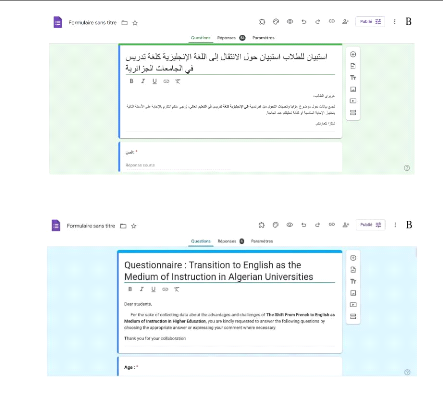
Figure 2.1.Google form questionnaire for students (Arabic) Figure 2.2. Google form questionnaire for students (English) As for the teachers, it proved challenging to schedule face-to-face interviews due to their heavy workloads during the fieldwork period (late April to early May). The majority of the contacted teachers were unavailable for in-person interviews. Consequently, they requested to complete the interview questions in a digital format, and this option was provided. The researchers contacted 33 teachers and administered a Google Form in two languages, English and French, ultimately obtaining responses (in both hard copy and digital form) from 12 teachers (06 from each institute). This constituted a non-probability, voluntary response sample, comprising those faculty members who chose to participate from the initially approached group. 24 CHAPTER TWO METHODOLOGY, DATA ANALYSIS AND INTERPRETATION
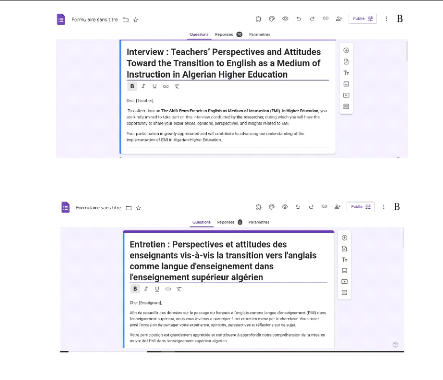
Figure 2.3. Google form interview for teachers (English) Figure 2.4. Google form interview for teachers (French) 2.5. Treatment of Data The data collected from the interviews will be analyzed using qualitative data analysis methods. This process involves organizing the collected data and conducting a thematic analysis to identify recurring themes or patterns related to teachers' perspectives and attitudes toward the transition. Responses will be systematically coded by categorizing them into key themes, followed by an in-depth interpretation to uncover the underlying meanings and gain insights into teachers' experiences and viewpoints. As for the questionnaire, the data collected will be analyzed using quantitative data analysis methods. Responses will be compiled and statistically organized by calculating frequencies, percentages, and means to summarize the findings. Cross-tabulation will be employed to examine relationships between variables, and charts 25 CHAPTER TWO METHODOLOGY, DATA ANALYSIS AND INTERPRETATION and graphs will be used to present the results clearly, enhancing visualization and comprehension of the data 2.6. Data Analysis This section is dedicated to the analysis of the results of the questionnaire and the interview. 2.6.1. Questionnaire Analysis The survey encompassed both the Institute of Science and the Institute of Technology, targeting students across all academic levels, from first-year undergraduate (Licence) to second-year Master's programs. The questionnaire was designed to explore multiple dimensions of the transition to English as a Medium of Instruction (EMI), including: general background information, students' attitudes toward EMI, the challenges they encountered, the availability and effectiveness of learning and support resources, and their overall perceptions and suggestions regarding the shift to English. |
|