|
English Language Integration in the Algerian Context: The Shift from French to EMI in Higher Education The Case of the Institute of Science and the Institute of Technology at Naama University Centrepar Bachir&Linda BOUARAF&AMRANI Naama-Algérie - Master en Langue Anglaise 2025 |

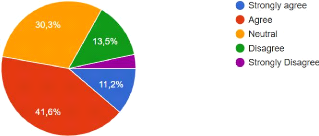
Section 4: Overall Perception and SuggestionsQ13: Do you think the shift to English as the medium of instruction was implemented effectively?
37 Figure 2.16. Effectiveness of Implementation of EMI The responses concerning the perceived effectiveness of the implementation of the shift to EMI present a divided perspective among the student population. While a majority expressed agreement, with 11.2% 'strongly agreeing' and 41.6% 'agreeing,' indicating a positive assessment of the implementation process (totaling 52.8%), a substantial proportion held a more neutral or negative view. Specifically, 30.3% of respondents adopted a 'neutral' stance, suggesting a lack of a firm opinion or perhaps an observation of both positive and negative aspects. Furthermore, a notable segment expressed disagreement, with 13.5% 'disagreeing' and 3.4% 'strongly disagreeing' with the effectiveness of the implementation. This combined negative sentiment (16.9%) highlights areas of concern or perceived shortcomings in CHAPTER TWO METHODOLOGY, DATA ANALYSIS AND INTERPRETATION the transition process. The presence of a large neutral group suggests that a significant portion of the student body may be either undecided or observing the ongoing effects of the policy. These findings underscore the need for a nuanced understanding of the factors influencing these varying perceptions and for ongoing evaluation and potential adjustments to the implementation strategy to address student concerns and optimize the transition process. Q14: Do you believe the transition will ultimately benefit Algerian higher education? Why? or why not? Table 2.7. Respondents' Opinions on the Benefits of EMI
38 Figure 2.17. Respondents' Opinions on the Benefits of EMI 39 CHAPTER TWO METHODOLOGY, DATA ANALYSIS AND INTERPRETATION The majority of students (84%) believe that the implementation of EMI will be beneficial for Algerian higher education, 4% think the opposite and 11% remain without opinion or skeptical. This reflects a positive attitude toward the implementation of EMI. Why? or why not? Table 2.8. Respondents' Justification for the Opinions on the Benefits of EMI
0 5 10 15 20 25 30 35 40 45 Figure 2.18. Respondents' Justification for the Opinions on the Benefits of EMI 40 CHAPTER TWO METHODOLOGY, DATA ANALYSIS AND INTERPRETATION The second part of the question allows us to collect qualitative data to dig deeper to better situate these opinions. The responses can be grouped into five common themes:
These responses supported the transition in theory but expressed doubts about its current implementation, suggesting that more groundwork (like early English education) is necessary. 41 CHAPTER TWO METHODOLOGY, DATA ANALYSIS AND INTERPRETATION Example: «Logically yes... but it must be taught from primary school to promote it within society.» 5. Opposition or Skepticism (6 responses - 7%) A small number of responses questioned the need for or benefits of the transition, emphasizing that quality education can happen in any language. Example: «No, knowledge is unlimited... What matters is the quality of education. Language is just a means.» This classification reveals that while there is broad support for the shift to English as a medium of instruction, it is mostly grounded in its perceived global utility and access to resources. However, concerns about implementation and inclusivity remain noteworthy. Q15: What are your suggestions to improve the transition to English as the medium of instruction? The concluding open-ended question of the questionnaire, designed to elicit suggestions and proposals for the rational and effective implementation of English as a Medium of Instruction (EMI), yielded a substantial number of responses, indicating a significant level of engagement among the participants. The richness of the data was evident in the multiple suggestions articulated within individual responses, resulting in a total count of recommendations exceeding the number of respondents. These diverse proposals were subsequently subjected to a process of thematic categorization to facilitate systematic analysis. 42 CHAPTER TWO METHODOLOGY, DATA ANALYSIS AND INTERPRETATION Table 2.9. Respondents' Suggestions to Improve the Transition to EMI
Teacher Availability of Early and Student Policy and Cultural No Suggestion Training and Resources Gradual Support and Curriculum Integration Qualification and Materials Introduction Language Reform and
Exposure Figure 2.19. Respondents' Suggestion to Improve the Transition to EMI 1. Teacher Training and Qualification (27 responses -- 21%) Respondents emphasized that teachers must be adequately trained in English, especially in scientific disciplines. Common points: ? Teacher training courses ? English proficiency for lecturers ? Scientific English specialization Example: "Teachers must be trained in English language to facilitate the transmission of information." 43 CHAPTER TWO METHODOLOGY, DATA ANALYSIS AND INTERPRETATION 2. Availability of Resources and Materials (20 responses -- 16%) Participants called for more accessible English-language resources, such as:
Example: "Use it as a language of communication even outside the classroom." No Suggestion (17 responses -- 13%) Some respondents explicitly stated no suggestions or left the response blank. 44 CHAPTER TWO METHODOLOGY, DATA ANALYSIS AND INTERPRETATION 2.6.2. Interview Analysis The interview was conducted with teachers from both scientific and technological institutes who teach a variety of courses. Its primary aim was to gather their perspectives on the transition to English as a Medium of Instruction (EMI), to explore their attitudes toward this linguistic shift, and to identify the challenges they have encountered in moving from French to English as the primary language of instruction. Q1. Could you briefly, tell us about your teaching experience, academic background, subject taught? The sample of interviewed teachers represents a well-qualified and experienced cohort from Science and Technology institutes. While most were academically trained in French, there's an evident willingness and effort to adapt to EMI. Their background positions them well to comment on the practical challenges and implications of the EMI policy in Algerian higher education.
Several teachers indicated they initially taught in French, but have since transitioned to or incorporated English into their teaching. 45 CHAPTER TWO METHODOLOGY, DATA ANALYSIS AND INTERPRETATION Q2. What is your general opinion about the shift from French to English as the medium of instruction in Algerian higher education? The teachers generally acknowledge the potential long-term benefits of adopting English as the medium of instruction, particularly in terms of global engagement and academic advancement. However, there is a strong undercurrent of concern regarding the practical challenges of implementing such a significant linguistic shift, especially concerning the preparedness of both educators and students, and the provision of adequate support and resources.
Another opinion highlights the importance of the step but emphasizes its current "fragile" state and the necessity for careful study by relevant authorities. 46 CHAPTER TWO METHODOLOGY, DATA ANALYSIS AND INTERPRETATION Q3. What challenges do you face personally in adapting to EMI? The responses reveal several recurring challenges among teachers adapting to EMI in Algerian higher education. The primary challenges revolve around linguistic limitations, lack of formal training, and student preparedness. Teachers recognize the value of EMI but indicate that without structured support, the transition may compromise teaching quality and learning outcomes.
A few teachers express a positive or adaptive attitude, saying they have managed to adjust over time, despite initial difficulties. Others report taking personal steps such as focusing on phonetics, articulation, and self-improvement in spoken English. 47 CHAPTER TWO METHODOLOGY, DATA ANALYSIS AND INTERPRETATION Q4. Do you feel adequately prepared to teach in English? The responses from teachers reveal a clear sense of partial or insufficient preparedness for teaching in English, despite some personal motivation and gradual progress.
One teacher notes that preparedness varies depending on the subject taught and the students' level, suggesting that EMI challenges may not be uniform across disciplines or academic levels. Q5. Following the transition to EMI, do you teach your courses only in English? The data shows that full implementation of EMI is not yet widespread among the teachers. Instead, code-switching between English, French, and even Arabic is a common and necessary practice. 48 CHAPTER TWO METHODOLOGY, DATA ANALYSIS AND INTERPRETATION
Teachers use other languages strategically, not out of resistance, but to facilitate understanding and ensure learning outcomes, especially in scientific and technical subjects. Q6. Do you code switch to arabe or french to get your message across if it seems like it is not understood and the knowledge it carries is not assimilated ? The responses clearly show that code-switching is a widespread and consciously adopted strategy among teachers to ensure effective communication and student understanding during EMI. a) Unanimous Use of Code-Switching 49 CHAPTER TWO METHODOLOGY, DATA ANALYSIS AND INTERPRETATION All respondents affirmed that they do code-switch to Arabic and/or French during instruction when needed. The primary reason cited was to enhance understanding and simplify complex concepts.
Responses highlight that the decision to switch languages is typically situational, based on: student reactions, topic difficulty, and communication breakdown Q7. How do you think the transition to EMI has affected the quality of your teaching? The responses reveal that while the initial phase of the transition to EMI can negatively impact teaching quality, most teachers believe it eventually leads to greater professional competence, improved teaching methodology, and access to cutting-edge scientific material. a) Mixed Impact on Teaching Quality Several teachers acknowledged an initial decline in teaching quality due to linguistic limitations. Others indicated that this decline is temporary and will improve with time and adaptation. ? "At the start, there was certainly a drop in quality - I was less articulated, less confident..." ? "At the beginning, it can take a negative impact..." 50 CHAPTER TWO METHODOLOGY, DATA ANALYSIS AND INTERPRETATION
One teacher pointed out that the effect on teaching is dependent on student motivation and adaptability:
53 CHAPTER TWO METHODOLOGY, DATA ANALYSIS AND INTERPRETATION These likely reflect either limited experience, uncertainty, or hesitation in expressing views. 2.7. Data Interpretation The analysis of the results provides strong evidence in support of the first hypothesis: the implementation of English as a language of instruction (EMI) in Algerian higher education faces considerable human and material challenges. Students acknowledge difficulties in understanding course content and a lack of classroom activity due to a lack of English proficiency. For their part, teachers report that their training was conducted in French, their teaching experience was also based in French, and that their lack of mastery of scientific vocabulary in English constitutes a handicap. They emphasize the need for specialized training in academic English and technical vocabulary, as well as updated teaching materials in English. These results show that in the absence of sufficient institutional support, particularly in terms of training, resources, and time, the transition to EMI could exacerbate existing educational inequalities rather than improve academic outcomes. The second hypothesis is also confirmed and supported by the results. A significant number of teachers admit that they experience significant constraints in adapting to EMI, particularly for oral communication, explaining scientific concepts, and interacting with students. Those of the old generation express particular difficulties in maintaining their teaching level, particularly in terms of clarity and precision. To address this shortcoming, almost all teachers admitted to using code-switching to French or Arabic. This practice was often presented as a necessary strategy to ensure understanding and preserve the quality of teaching. This practice was used when students seemed confused, when scientific terminology was too complex, or when fundamental understanding was compromised, or sometimes at the request of the students themselves. Thus, code-switching emerged as both a pedagogical tool and a mechanism for adapting to the language transition. The third hypothesis receives only partial confirmation. It postulates that the change in language of instruction would not significantly affect students' 54 CHAPTER TWO METHODOLOGY, DATA ANALYSIS AND INTERPRETATION comprehension, since their levels in French and English are assumed to be similar. Although some students report having moderate familiarity with English, particularly due to its use in previous courses and online content, the overall results indicate that their level in French remains better. Most students reported that, unlike French, courses taught in English compromise their comprehension and assimilation of knowledge. In addition, the switch to French or Arabic by teachers significantly improved their comprehension. These results show that the level of English is still not sufficient for most students to allow for complete assimilation of knowledge, especially in complex or technical modules. Overall, a positive attitude toward the transition to EMI was expressed by both teachers and students, recognizing its long-term benefits and its alignment with international academic trends. English is seen as the language of scientific research and international communication, and most participants supported this transition. However, they also emphasized the importance of a gradual and well-managed transition, rather than one that was rushed and imposed all at once. The main stakeholders undergoing this transition (teachers and students) desired more structured support, including practical workshops, pedagogical days, internships, and discipline-specific language training. Teachers expressed their willingness to adapt and improve further, provided they had the necessary time and resources. In conclusion, the implementation of EMI in Algerian higher education has proven complex and requires the combined efforts of all stakeholders (teachers, students, and administrations). While this transition is widely welcomed and recognized as necessary for academic modernization, the current state of preparedness of all students and teaching staff remains limited. To ensure the effectiveness and reliability of this transition, a national policy of support for teachers through continuing education, and for students through support courses, improved availability of materials and strategic implementation will be essential. 55 CHAPTER TWO METHODOLOGY, DATA ANALYSIS AND INTERPRETATION 2.8. Suggestions and Recommendations
2.9. Contribution to Knowledge This research is another small stone in the edifice of existing knowledge on the transition to English as a language of instruction (EMI) in Algerian higher education. It provides an empirical framework from the little-explored context of Algerian higher education, particularly at the Naama University Centre, to shed light on the 56 CHAPTER TWO METHODOLOGY, DATA ANALYSIS AND INTERPRETATION opinions and attitudes of teachers and students towards this transition. The simultaneous examination of the perceptions of the main actors undergoing this change (students and teachers) offers a comprehensive and nuanced understanding of the challenges and constraints associated with the transition from French to English. It also offers claims and speculations on the chances of success of this transition. The results obtained rigorously confirm the existence of human and material obstacles that hinder the implementation of EMI, while demonstrating the crucial need for teachers to resort to code-switching, they also confirm the tangible impact of language change on students' knowledge assimilation. Therefore, this study not only validates specific theoretical concerns regarding the adoption of EMI in non-English-speaking contexts, but also provides practical and context-specific pedagogical suggestions and recommendations derived from the complaints and concerns of teachers and students, essential to inform future policies and practices during similar language transitions. 2.10. Research Limitations This study, although providing valuable insights into the implementation of English as a medium of instruction (EMI) in Algerian higher education, is not without limitations due to the context in which it took place. First, the conduct of the study in the Namma University Centre and in only two of these institutes does not allow the researchers to claim generalization to the entire academic body of Algerian higher education. Second, the data collection period, between late April and early May, which generally coincides with a potentially high academic workload for students and teachers towards the end of the semester, influenced the participation rates and the nature of the responses. As a result, the sample size of participating teachers (n = 12) is relatively small and may limit the generalizability of their perspectives to the entire teaching body. Third, the student questionnaire had a potential overrepresentation of the female gender, which could introduce a gender bias into the overall perception of certain aspects related to the transition to EMI, such as the level of comfort, the challenges encountered and the 57 CHAPTER TWO METHODOLOGY, DATA ANALYSIS AND INTERPRETATION perceived benefits. Finally, the use of self-reported data from students and teachers introduces the possibility of response bias. These limitations recommend future larger, more diverse and more representative studies, conducted over longer periods and in several universities, in order to have a global vision and a more complete understanding of the implementation of EMI in Algeria. 2.11. Conclusion This chapter presents the practical aspects of this research study, outlining the methodology, data collection instruments, and sample characteristics. Quantitative data was collected through student questionnaires and qualitative data from teacher interviews. The results confirmed the research hypotheses, with the first two hypotheses supported and the third receiving partial support. The chapter also discusses the study's contribution to existing knowledge and suggests recommendations for improving EMI implementation. However, it acknowledges limitations such as the study being conducted in a single university, data collection period, and sample imbalances, which may affect the generalizability of the results. GENERAL CONCLUSION 59 GENERAL CONCLUSION The adoption of English as a Medium of Instruction (EMI) in Algerian higher education is a source of great interest and debate. This issue has a political and ideological base; owing primarily to the ongoing conflict between Arabic and French in Algeria's linguistic landscape. As a result, any attempt to question the status of French in this environment sparks passionate controversy. Moreover, the increased demand for English instruction has put considerable strain on Algerian educational system to quickly adopt the transition to this language as a means of instruction; allowing Algerian universities to reach international levels, gaining visibility, and following global trends. Hence, this study attempts to evaluate the first year of the transition from French to English as medium of instruction in Algerian higher education. It seeks to shed light on the challenges facing this shift, highlight the attitudes and opinions of teachers, and delve in students' attitudes and degree of assimilation of knowledge when studying with EMI. To reach this objective, a mixed descriptive approach has been used to collect quantitative data throughout a questionnaire administered on hard copy and via google form to students from sciences institute and technologies institute of Naama university centre; and qualitative data through an interview destined to teachers from the same institutes. The analysis of the collected data shows a positive attitude towards the shift to EMI and an optimism about its success and its benefits for Algerian higher education. This positive outlook is often linked to the perception of English as a global language that provides access to broader academic resources and improves future career prospects. Nevertheless, the main actors report on the difficulties and challenges that accompany this transition. Students insist on language proficiency, difficulties understanding course materials and participating in class, and the need for support and resources. From their part, the primary challenges of teachers revolve around linguistic limitations, lack of formal training, and student preparedness. 60 To overcome these challenges, a personalized support program is necessary for both students and teachers. In addition, a willingness to accept code-switching as a strategy which will facilitate a smooth and effective transition. Furthermore, a policy aims at providing students with the necessary resources (books, labs, multimedia materials...etc) is hopefully desirable and will have great contribution. Finally, workshops, intensive courses, and online courses are other ways to improve English proficiency. This study provides valuable insights into the challenges of transitioning to EMI at Naama University Centre in Algeria. By exploring the perspectives of both students and teachers, it highlights key obstacles, such as human and material limitations, teachers' reliance on code-switching, and the impact of language change on students' learning. The findings validate theoretical concerns about EMI adoption in non-Anglophone contexts and offer practical recommendations for policy and pedagogical adjustments during similar transitions. This piece of research has; indeed, some limitations, as it was conducted at Naama University Centre and in only two of its institutes. The data collection period (April- May) is also a limiting factor, as it is marked by a heavy workload for students and teachers, which influences the number of respondents for teachers. The overrepresentation of women in the questionnaire may bias the analysis of the results in certain aspects. Future studies that go beyond these limitations and broaden the scope of research are required and solicited to better assess and optimize the implementation of EMI in Algeria. This leads to a pertinent question for subsequent inquiry: how can a sustainable and equitable framework for EMI integration be developed and evaluated across the diverse sociolinguistic contexts of Algerian higher education, ensuring both linguistic proficiency and uncompromised knowledge assimilation?" REFERENCES 62 REFERENCES
63
64
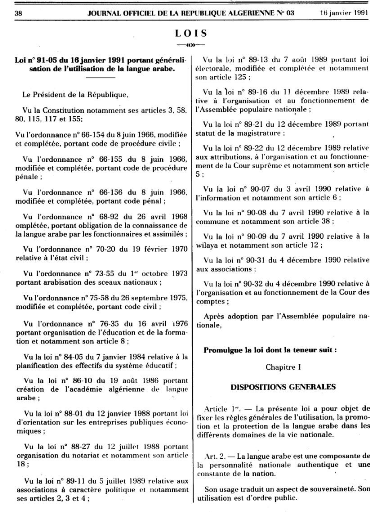
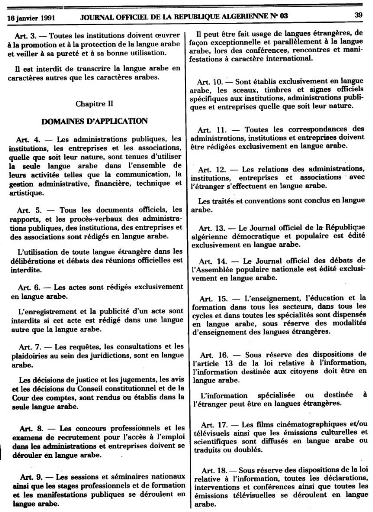
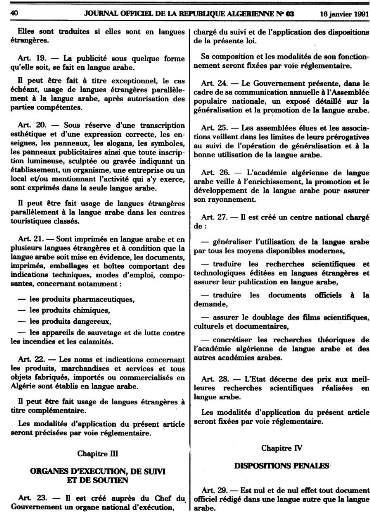
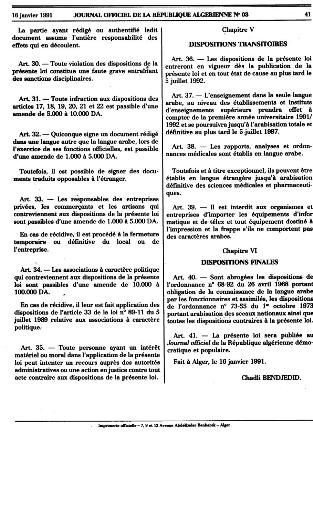
APPENDICES 66 APPENDICES Appendix 1 : Loi n° 91-05 du 16 janvier 1991 portant généralisation de l'utilisation de la langue arabe.
67
68
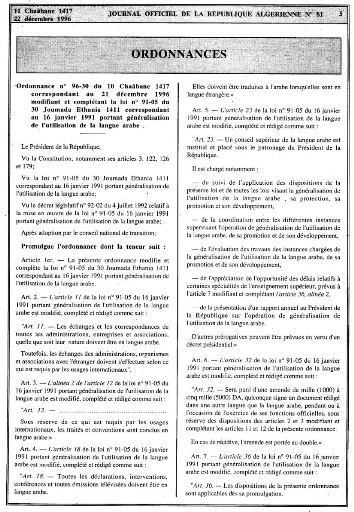
69 70 Appendix 2 : Ordonnance no 96-30 du 21 décembre 1996 modifiant et complétant la loi no 91-05 du 16 janvier 1991 portant généralisation de l'utilisation de la langue arabe.
71
72 Appendix 3 : Interview for Teachers Interview : Teachers' Perspectives and Attitudes Toward the Transition to English as a Medium of Instruction in Algerian Higher Education Dear [Teacher], To collect data on The Shift From French to English as Medium of Instruction (EMI) in Higher Education, you are kindly invited to take part on this interview conducted by the researcher, during which you will have the opportunity to share your experiences, opinions, perspectives, and insights related to EMI. Your participation is greatly appreciated and will contribute to advancing our understanding of the implementation of EMI in Algerian Higher Education.
73
Thank you for your collaboration, your time and valuable insights. We truly appreciate your willingness to share your experiences and knowledge. This will contribute to the research. If you are intersted, we will share with you our findings. Appendix 4 : Interview for Teachers (French) Entretien : Perspectives et attitudes des enseignants vis-à-vis la transition vers l'anglais comme langue d'enseignement dans l'enseignement supérieur algérien Cher [Enseignant], Afin de recueillir des données sur le passage du français à l'anglais comme langue d'enseignement (EMI) dans l'enseignement supérieur, nous vous invitons à participer à cet entretien mené par le chercheur. Vous aurez ainsi l'occasion de partager votre expérience, opinions, perspectives et réflexions sur ce sujet. Votre participation est grandement appréciée et contribuera à approfondir notre compréhension de la mise en oeuvre de l'EMI dans l'enseignement supérieur algérien.
74
75
9. Y a-t-il autre chose que vous aimeriez partager sur votre expérience ou votre point de vue sur la transition vers EMI ? 76 Merci pour votre collaboration, votre temps et vos précieuses informations. Nous apprécions sincèrement votre volonté de partager votre expérience et vos connaissances. Cela contribuera à notre recherche. Si cela vous intéresse, nous partagerons nos conclusions avec vous. 77 Appendix 5: Questionnaire for Students Questionnaire : Transition to English as the Medium
of Dear students, For the sake of collecting data about the advantages and challenges of The Shift From French to English as Medium of Instruction in Higher Education, you are kindly requested to answer the following questions by putting a tick [ I on the appropriate answer or expressing your comment where necessary. Thank you for your collaboration Part one General Information Age : Gender : Male Female What is your field of study?
78 2. What is your primary language of instruction before the transition to English?
Parte two : Attitudes Toward English as Medium of Instruction 4. How do you feel about the transition from French to English as the medium of instruction?
5. How comfortable are you with studying in English?
6. Do you believe the shift to English will enhance your academic and professional opportunities??
79 Part Three: Challenges Encountered 7. What challenges are you facing while studying in English?
8. How often do you experience difficulty participating in class discussions or activities due to the language change?
9. Does the shift to English make it harder for you to understand and assimilate knowledge in your courses?
Part Four : Overall Perception and Suggestions 10. Do you think the shift to English as the medium of instruction was implemented effectively?
80
81 Appendix 6 : Questionnaire for Students (in Arabic) ÈáÇ Øáá äÇíÈÊÓÇ ÉíÑÆÇÒáÌÇ ÊÇÚãÇáÌ Ç í ÓíÑÏÊ ÉÛáß ÉíÒíáäÌáÅÇ ÉÛááÇ áìÅ áÇÞÊä áÇÇ áæÍ äÇíÈÊÓÇ ÈáÇØáÇ íÒíÒÚ ãíáÚÊáÇ í ÓíÑÏÊ ÉÛáßÉíÒíáäÌáÅÇ áìÅ ÉíÓäÑáÇ äã áæÍÊáÇ ÊíÇÏÊÍæ íÇÇÒã ÚæÖæã áæÍ ÊäÇÇíÈ ÚãáÌ .ÉÌÇáÍÇ ÏäÚ ãßÞ íáÚÊ ÉÈÇÊß æ ÉÈÓÇäáãÇ ÉÈÇÌáÅÇ ÑÇíÊÎÈÇ ÉíáÇÊáÇ ÉáÆÓáÇ ìáÚ ÉÈÇÌáÅÈÇ ãÑßÊáÇ ãßäã ìÌÑõí áíÇÚáÇ .ãßäæÇÚÊá ÇðÑßÔ :äÓáÇ :ÓäáÌÇ ÑßÐ ìËä
ÓäÇÓíá áìæáÇ ÉäÓáÇ ÓäÇÓíá ÉíäÇËáÇ ÉäÓáÇ ÓäÇÓíá ÉËáÇËáÇ ÉäÓáÇ ÊÑÓÇã áìæ ÉäÓáÇ ÓäÇÓíá ÉíäÇËáÇ ÉäÓáÇ 82 ÉíÒíáäÌáÅÇ
ØÓæÊã ÁíÓ íÚÖ
ÇðÞáÇØÅ ÍÊÇÑã íÑÛ ÍÊÇÑã íÑÛ ÏíÇãÍ ÍÊÇÑã ÇðãÇÊã ÍÊÇÑã ÉíäåáãÇæ ÉííãÏÇßáÇ ßÕÑ ÒÒÚíÓ )ÓíÑÏÊ ÉÛáß( ÉíÒíáäÌáÅÇ ÉÛááÇ áìÅ áæÍÊáÇ ä ÏÞÊÚÊ áå . 7 ÇãÇÊã ÞÇæã ÞÇæã ÏíÇãÍ ÞÇæã íÑÛ ÇãÇÊã ÞÇæã íÑÛ 1 1 1 1 ÉíÒíáäÌáÅÇ ÉÛááÈÇ ÉÓÇÑÏáÇ ÁÇäË ßåÌÇæÊ ÊíáÇ ÊíÇÏÍÊáÇ íå Çã .8 íÓÇÑÏáÇ ÑÑÞáãÇ ÏÇæã ãå í ÉÈæÚÕ ÉíÒíáäÌáÅÇ ÉÛááÇ í ÚÖ )áÎÅ æíÏíáÇ ÚØÇÞã ÈÊßáÇ( ÉíÇßáÇ ÑÏÇÕáãÇ ÕÞä ÉÐÊÇÓá Çäã ÏæÏãÍ ãÚÏ ìÑÎ . 9 áå ãÓÞáÇ áÎÇÏ ÉØÔäáÇ æ ÊÇÔÞÇäáãÇ í ÉßÑÇÔáãÇ í ÉÈæÚÕ åÌÇæÊ ßáÚíÌ ÉÛááÇ íÑíÛÊ ÇðãÆÇÏ ÇðÈáÇÛ ðäÇÇíÍ ÇðÑÏäÇ ÇðÏÈ ÉÑÚáãÇ ÈÇÚíÊÓÇæ ãå ßíáÚ ÈÚÕáÇ äã áÚíÌ ÉíÒíáäÌáÅÇ ÉÛááÇ áìÅ áæÍÊáÇ áå .
. 83 áÇÚ áßÔÈ åÐíäÊ Êã ÓíÑÏÊáá ÉÛáß ÉíÒíáäÌáÅÇ ÉÛááÇ áìÅ áæÍÊáÇ ä ÏÞÊÚÊ áå ÇãÇÊã ÞÇæã ÞÇæã ÏíÇãÍ ÞÇæã íÑÛ ÇãÇÊã ÞÇæã íÑÛ ÇÐÇáãæ ÇØáãÇ ÉíÇäå í íÑÆÇÒáÌÇ áíÇÚáÇ ãíáÚÊáÇ ìáÚ ÚäáÈÇ ÏæÚíÓ áæÍÊáÇ ÇÐå ä ÏÞÊÚÊ áå .1 2 ÓíÑÏÊáá ÉÛáßÉíÒíáäÌáÅÇ ÉÛááÇ áìÅ áÇÞÊäáÇÇ íäÓÍÊá ßÊÇÍÇÊÑÞÇ íå Çã.13 |
| ||||||||||||||||||||||||||||||||||||||||||||||||||||||||||||||||||||||||||||||||||||||||||||||||||||||||||||||||||||||||||||||||||||||||||||||||||||||||||||||||||||||||||||||||||||||||||||||||||||||||||||||||||||||||||||||||||||||||||||||||||||||||||||||||||||||||||||||||||||||||||||||||||||||||||||||||||||||||||||||||||||