Section 3: Challenges Encountered
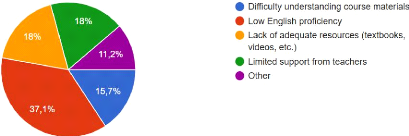
Q10: What challenges are you facing while studying in
English?
34
Figure 2.13. Challenges Faced while Studying in
English
The responses to the question concerning the challenges faced
while studying in English reveal several significant obstacles for the student
population. The most prevalent challenge identified was 'Low English
proficiency' (37.1%) indicating that a substantial proportion of
students perceive their current English language skills as a primary barrier to
their academic engagement within the new Medium of Instruction. A considerable
proportion (18%) also reported experiencing a 'Lack of
adequate resources (textbooks, videos, etc.)' specifically tailored
for English-based instruction, suggesting a potential gap in the availability
of suitable learning materials. Similarly, 'Limited support from
teachers' was cited by another 18% of respondents,
highlighting a perceived need for enhanced pedagogical strategies and
assistance from instructors to facilitate learning in English. Furthermore,
15.7% of students identified `difficulty understanding
course materials' as a major challenge. This may result from
linguistic complexity, technical vocabulary, or the instructional design of
materials not being adapted to non-native English speakers. Finally, the
'Other' category, representing 11.2% of
responses, suggests the presence of additional, less frequently articulated
challenges.
CHAPTER TWO METHODOLOGY, DATA ANALYSIS AND
INTERPRETATION
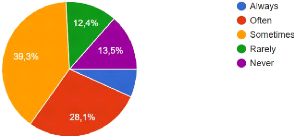
Q11: How often do you experience difficulty participating
in class discussions or activities due to the language change?
35
Figure 2.14. Difficulty Participating in Class Due to
the Language Change
The responses regarding students' difficulty participating in
class as a result of the language shift to English reveal a significant level
of linguistic barrier to active engagement. A substantial proportion of
respondents indicated experiencing difficulties with participation at least
some of the time, with 28.1% reporting this 'often'
and 39.3% stating 'sometimes.' This
combined percentage (67.4%) suggests that over two-thirds of
the student population encounter challenges in actively contributing to
classroom discussions and activities due to the change in the medium of
instruction. Furthermore, a notable fraction reported experiencing this
difficulty frequently, with 6.7% indicating 'always.'
In contrast, only a minority of students reported consistently
unaffected participation, with 13.5% stating 'never'
experiencing such difficulties and 12.4% reporting
'rarely.' These findings underscore the considerable impact of
the language transition on classroom dynamics and highlight the need for
pedagogical strategies that actively support and encourage participation from
students with varying levels of English proficiency
36
CHAPTER TWO METHODOLOGY, DATA ANALYSIS AND
INTERPRETATION
Q12: Does the shift to English make it harder for you
to understand and assimilate knowledge in your courses?
Table 2.6. Influence of EMI on Understanding and
Assimilation of
Knowledge
|
Response
|
Frequency
|
Percentage
|
|
Yes
|
37
|
42%
|
|
No
|
52
|
58%
|
|
Total
|
89
|
100%
|
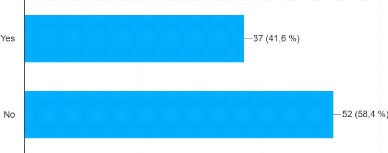
Figure 2.15. Influence of EMI on Understanding and
Assimilating Knowledge
The responses to the question regarding whether the shift to
English as the medium of instruction has made it more difficult to understand
and assimilate knowledge in their courses reveal a divided student body. A
significant proportion of the respondents, comprising 42%
(n=37), indicated that the linguistic transition has
indeed presented a barrier to their comprehension and knowledge acquisition.
Conversely, a larger segment, representing 58% (n=52) of the
participants, reported that the shift to English has not made it harder for
them to understand and assimilate course content. This near-majority suggests
that while a substantial group of students is experiencing increased cognitive
load or linguistic challenges impacting their
CHAPTER TWO METHODOLOGY, DATA ANALYSIS AND
INTERPRETATION
learning, a greater number do not perceive a significant
obstacle to their understanding due to the change in the medium of instruction.
These findings highlight the heterogeneous impact of the EMI policy on
students' learning experiences and underscore the importance of providing
targeted support for those experiencing difficulties while also acknowledging
the adaptability of a significant portion of the student population.
|